Sharp Daily
No Result
View All Result
Thursday, June 11, 2026
  • Home
  • News
    • Politics
  • Business
    • Banking
  • Investments
  • Technology
  • Startups
  • Real Estate
  • Features
  • Appointments
  • About Us
    • Meet The Team
Sharp Daily
  • Home
  • News
    • Politics
  • Business
    • Banking
  • Investments
  • Technology
  • Startups
  • Real Estate
  • Features
  • Appointments
  • About Us
    • Meet The Team
No Result
View All Result
Sharp Daily
No Result
View All Result
Home Banking

Key ratios to check before investing in bank stocks

Patricia Mutua by Patricia Mutua
June 12, 2024
in Banking
Reading Time: 2 mins read

Following the release of attractive financial results and dividends announcement in the Kenyan banking sector, investors have rushed to get a share of the seemingly lucrative returns.

However, investing in bank stocks requires a careful analysis of financial ratios to assess the health and profitability of the banks. In Kenya, where the banking sector is a significant part of the economy, certain key ratios stand out for investors.

The Return on Equity (ROE) is a critical measure of profitability, indicating how effectively a bank is using its equity to generate profits. A higher ROE suggests a more efficient bank.

The Net Interest Margin (NIM) is another vital ratio, showing the difference between the interest income generated and the amount of interest paid out to lenders, relative to the bank’s interest-earning assets. A stable or growing NIM indicates a bank’s ability to manage its interest income and expenses effectively.


RELATEDPOSTS

How financial institutions can break away from vendor monopolies

November 14, 2025

KESONIA: Transforming Kenya’s benchmark interest rate framework

October 13, 2025

Loan to Deposit Ratio (LDR) measures a bank’s liquidity by comparing its total loans to its total deposits. A higher LDR can suggest that a bank is aggressively lending, which could be profitable but also risky if not managed properly.

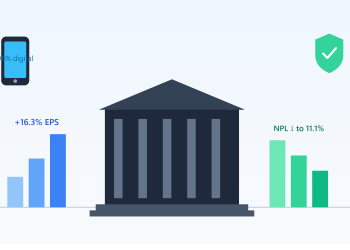
The Non-Performing Loans (NPL) ratio is essential for evaluating the quality of the bank’s loan portfolio. A lower NPL ratio means fewer loans are at risk of default, indicating a healthier credit environment.

The Cost to Income Ratio (CIR) helps investors understand how efficiently a bank operates by comparing its operating expenses to its net revenue. A lower CIR is preferable, as it suggests the bank is controlling its costs and maximizing its income.

For investors in Kenya, it’s also important to consider the banks’ Capital Adequacy Ratio (CAR), which measures a bank’s capital against its risks. A higher CAR indicates that a bank has a cushion to absorb potential losses, making it a safer investment.

Additionally, the Price to Book (P/B) ratio compares a bank’s market value to its book value, providing insight into whether a stock is undervalued or overvalued. These ratios, when analyzed together, give a comprehensive view of a bank’s financial health and help investors make informed decisions when investing in Kenyan bank stocks.

It’s advisable to look at these ratios in the context of the overall Kenyan economy and the banking sector’s performance to understand the potential risks and rewards fully.
Previous Post

Fraudster masquerading as journalist nabbed for fleecing prominent figures

Next Post

OPINION: How Kenya can alleviate financial strain on companies

Patricia Mutua

Patricia Mutua

Related Posts

Banking

CBK holds benchmark rate at 8.75% for the second consecutive time

June 10, 2026
Banking

Kenyans faces higher loan repayments as bankers push for CBR hike

June 5, 2026
Banking

Kenya’s Sh1,000 note tightens grip on cash economy as currency in circulation nears Sh400 billion

June 2, 2026
Analysis

Reading between the numbers in Q1’2026 banking financials

May 22, 2026
Banking

NCBA shareholders have until 10 July 2026 to accept Nedbank’s KSh 105 0ffer

May 4, 2026
Analysis

How Kenyan banks are rebalancing risk and opportunity

April 7, 2026

LATEST STORIES

Kenya’s interest rate hold: when geopolitics reshapes monetary policy

June 10, 2026

CMA tightens governance oversight in kakuzi case

June 10, 2026

Investor appetite for treasury bills surges as demand jumps 228% ahead of CBK rate decision

June 10, 2026

CBK holds benchmark rate at 8.75% for the second consecutive time

June 10, 2026

The appeal of SACCOs

June 9, 2026

Court upholds wells fargo staff dismissals, reduces compensation award

June 9, 2026

Kenya moves to regulate tech driven delivery platforms with landmark licensing rules

June 9, 2026

The Rise of Asset-Light Businesses: How Value Creation Is Shifting from Ownership to Ecosystems

June 9, 2026
  • About Us
  • Meet The Team
  • Careers
  • Privacy Policy
  • Terms and Conditions
Email us: editor@thesharpdaily.com

Sharp Daily © 2024

No Result
View All Result
  • Home
  • News
    • Politics
  • Business
    • Banking
  • Investments
  • Technology
  • Startups
  • Real Estate
  • Features
  • Appointments
  • About Us
    • Meet The Team

Sharp Daily © 2024