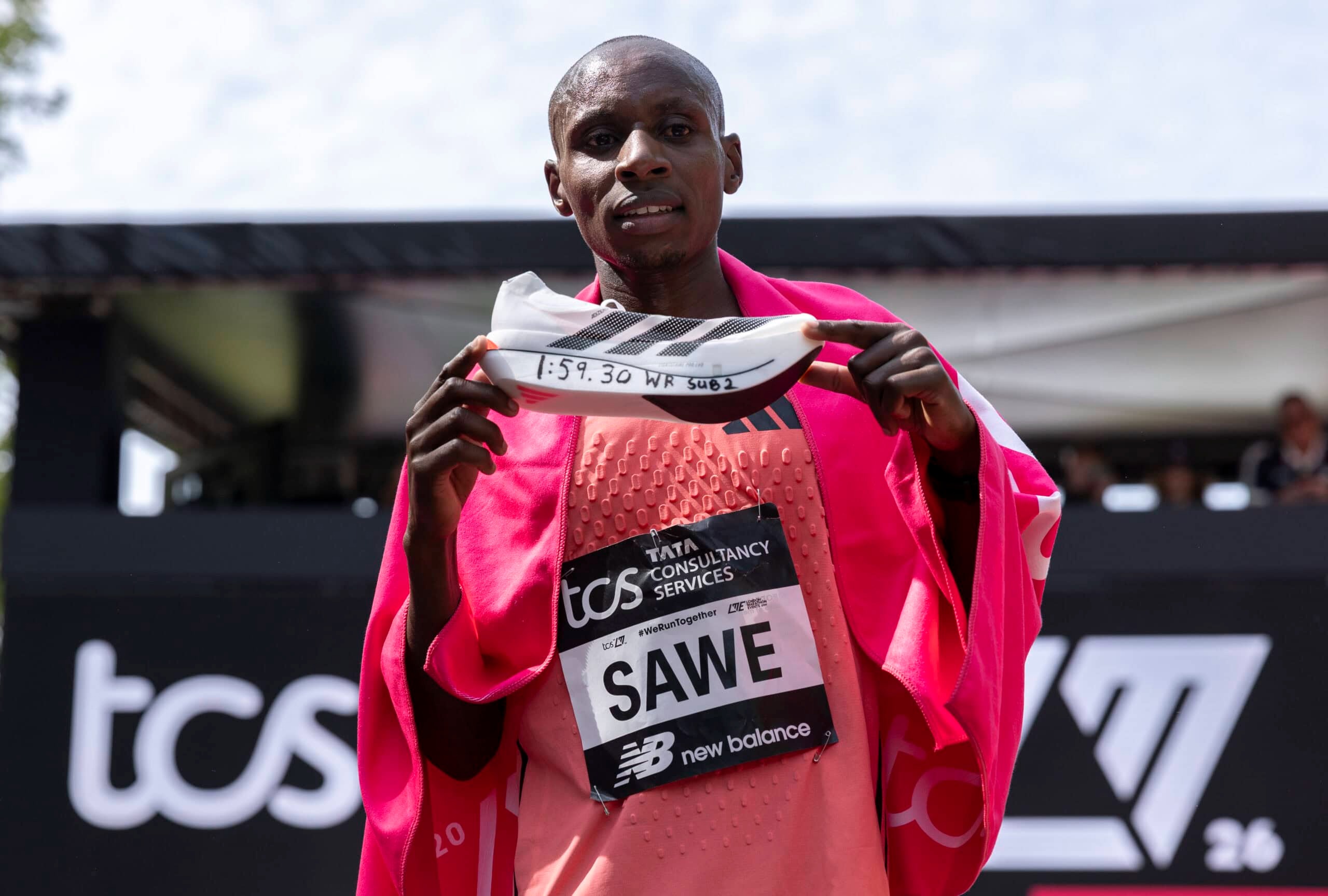


When Sabastian Sawe crossed the finish line in 1 hour, 59 minutes and 30 seconds, he did something no Kenyan had ever done in an official marathon. He ran faster than two hours. And he did it on a standard course, with standard rules, in front of 50,000 other runners.
The previous world record belonged to Kenya’s Kelvin Kiptum: 2:00.35. Sawe beat that by 65 seconds. He also beat Eliud Kipchoge’s unofficial 1:59.40 from the 2019 Vienna exhibition, the one with rotating pacemakers and a specially designed course that did not count for the record books.
This one counts.
For Kenyan runners, that changes things.
What changes now
The first change is money. Sawe earned $55,000 in prize money plus a world-record bonus. That is about KSh 14 million without the sum of the bonuses. It is a good payday. But the real money comes next.
Marathon appearance fees are what top Kenyan runners live on. Organizers in Berlin, Chicago, Tokyo, and Boston pay six-figure US dollar guarantees just to get a name on the start line. Before Sunday, the going rate for a Kenyan with a world record was high. Now it will be higher.
A Nairobi-based sports agent, speaking to Bloomberg on condition of anonymity because he is currently negotiating contracts, put it simply: “Every Kenyan marathoner just got a raise.”
The shoe company angle
Sawe wore Adidas. Not Nike. That matters because Nike has dominated Kenyan distance running for nearly a decade through Kipchoge’s profile and the Vaporfly franchise.
Adidas has been trying to catch up. Sawe’s prototype shoe weighs 3.4 ounces in a men’s size 9 — less than half the weight of a standard running shoe. The company has not said when it will be sold publicly. But the London Marathon was effectively a live advertisement.
In training camps across the Rift Valley, runners will notice. Young athletes who used to want only Nike will now have a second serious option. That competition is good for Kenyan runners. It pushes both companies to offer better contracts.
The technology question
Not everyone is comfortable with how fast shoes have changed. Carbon-fibre plates and super foams have lowered times across the sport. Some critics call it technological doping. World Athletics president Sebastian Coe has said he wants innovation without an arms race.
In Kenya, most fans and former runners do not lose sleep over this. Sawe still ran the second half of the race in 59:01. He still pulled away from Ethiopia’s Yomif Kejelcha in the final two kilometers on his own legs. No shoe runs for you.
But the question does matter for young runners in Iten and Kaptagat. If record times depend partly on prototype shoes that are not available to everyone, then the sport is not completely fair. Sawe earned his record. The next Kenyan chasing it should not need a factory sample to compete.
What does this mean for Kenyan dominance?
Kenya now has three men’s marathon world-record holders from the past three years: Kiptum (2023), Kipchoge (2022), and Sawe (2024). No other country has that depth.
The women’s race in London went to Ethiopia’s Tigst Assefa in 2:15:41. But Kenya’s Hellen Obiri ran a personal best for second place, and Joyciline Jepkosgei took third. That is not a defeat. It is proof that Kenya still produces more top-end talent than any other nation.
The difference now is that the target has moved. The next question is how far under two hours someone can go. And it is hard to bet against a Kenyan being the one to find the answer.
A final note on Sawe
He said after the race that the crowds helped him. “If it was not for them, you don’t feel like you are so loved,” he said. That is a simple statement. But it is also the truth about how Kenyan runners have always worked — they run for themselves, for their families, and for the people watching.
He also said this day was not for him alone. In a sport where Kenya has produced more great distance runners than any other country, that is not false modesty. It is just accurate.
The record is his name. But the economy that follows better contracts, more attention, and higher appearance fees belongs to every Kenyan who lines up at a starting line next year.