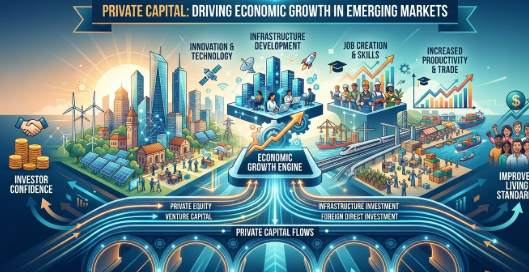
The global development finance landscape is undergoing a structural transformation as countries increasingly rely on private capital rather than traditional foreign aid to finance economic growth and infrastructure development. Fiscal pressures in donor countries, shifting geopolitical priorities, and rising public debt have constrained the availability of concessional financing, prompting governments to seek more sustainable sources of investment. Consequently, foreign direct investment (FDI), private equity, venture capital, infrastructure funds, and public-private partnerships (PPPs) have become increasingly important in supporting long-term economic development, particularly across emerging markets.
Unlike foreign aid, which primarily finances humanitarian assistance and social development programmes, private capital targets commercially viable investment opportunities that generate competitive financial returns. Investors evaluate markets based on economic performance, regulatory certainty, governance standards, and long-term growth potential before committing capital. As competition for international investment intensifies, governments are implementing reforms that improve the ease of doing business, strengthen legal and regulatory institutions, and create predictable investment environments capable of attracting both domestic and international investors.
Recent data from the United Nations Conference on Trade and Development (UNCTAD) illustrates this shift in global investment activity. Global foreign direct investment increased by 14.0%, driven largely by financial flows through international investment hubs and rising investment in digital infrastructure. Although investment activity has recovered globally, capital flows remain uneven across regions as investors increasingly prioritize countries with strong macroeconomic fundamentals, political stability, quality infrastructure, skilled labor, and transparent governance. These factors have become critical determinants of investment decisions as businesses seek resilient markets capable of supporting long-term growth.
The transition toward private capital is also reshaping the way governments finance infrastructure development. Rather than depending exclusively on concessional loans and donor-funded programmes, many countries now partner with private investors to finance transport infrastructure, renewable energy, affordable housing, healthcare facilities, water systems, and digital infrastructure. Public-private partnerships have emerged as an important financing mechanism because they mobilize private sector expertise and investment while reducing pressure on government budgets. These partnerships also improve project delivery, encourage innovation, and support more efficient allocation of public resources.


For Kenya, the growing importance of private capital presents significant opportunities to accelerate economic development. The country has established itself as one of East Africa’s leading investment destinations through its strategic geographic position, diversified economy, expanding financial sector, and vibrant technology ecosystem. Continued investment across renewable energy, manufacturing, logistics, real estate, and information and communication technology (ICT) has strengthened Kenya’s attractiveness to international investors seeking exposure to Africa’s long-term growth potential.
However, sustaining investor confidence will require continued improvements in the domestic investment environment. Fiscal discipline, prudent public debt management, regulatory consistency, efficient public institutions, and transparent governance remain essential for attracting long-term investment. Predictable tax policies, effective public service delivery, and a stable business climate reduce investment risk and encourage businesses to commit capital over extended periods. At the same time, strengthening domestic capital markets and encouraging greater participation by pension funds, insurance companies, and other institutional investors can mobilize local savings to complement foreign investment in financing national development priorities.
The increasing role of private capital reflects a broader evolution in global development finance, where sustainable economic growth depends more on productive investment than traditional aid flows. Countries that maintain sound macroeconomic policies, strengthen governance, improve infrastructure, and create competitive investment environments are likely to attract greater capital inflows while supporting private sector expansion and long-term economic resilience. For Kenya, combining targeted policy reforms with increased private investment offers an opportunity to finance infrastructure, stimulate job creation, strengthen industrial development, and reduce long-term dependence on external development assistance. As global investment patterns continue to evolve, private capital is expected to remain a central pillar of sustainable economic growth across emerging markets.