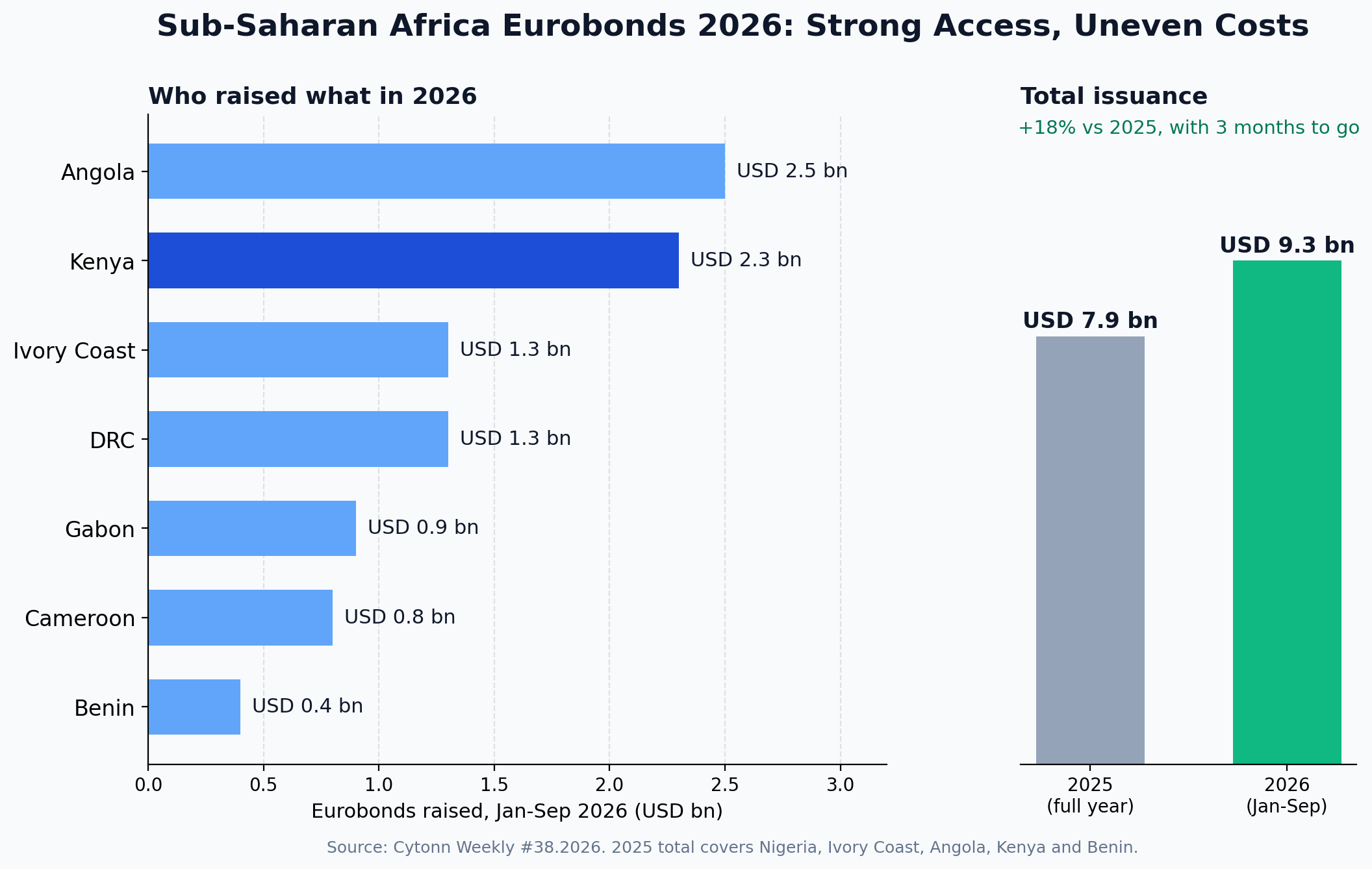
Sub-Saharan Africa’s return to international bond markets has carried well into 2026, and the numbers show a region that can once again borrow abroad in size, though not always cheaply. Between January and September, seven sovereigns (Angola, Kenya, Ivory Coast, the DRC, Gabon, Cameroon and Benin) raised roughly USD 9.3 billion through Eurobond issuances, up from the USD 7.9 billion raised by Nigeria, Ivory Coast, Angola, Kenya and Benin across all of 2025. Governments have leaned on these markets to refinance maturing obligations, plug budget gaps and fund development projects, and investors have shown up in force. Most of the 2026 deals were heavily oversubscribed, with Benin’s twelve-year bond drawing bids equal to more than eight times the amount on offer, Ivory Coast’s fifteen-year bond attracting close to five times, and the DRC’s two tranches drawing over four times.
What stands out this year is how many of these deals were about managing debt rather than just adding to it. Kenya returned to the market in February with a USD 2.3 billion dual-tranche issue, a seven-year bond at a 7.9% coupon and a twelve-year at 8.7%, while buying back part of its outstanding bonds to smooth out its repayment schedule. Angola paired its USD 1.5 billion issuance with a repurchase of its 2028 and 2029 notes, using about USD 0.8 billion to retire existing debt, and Benin tapped its existing 2038 bond for another USD 0.4 billion. Ivory Coast, meanwhile, showed what strong credibility buys: its USD 1.3 billion fifteen-year bond came at a 6.8% coupon, the cheapest of the year’s issuers, on the back of orders topping USD 6 billion. At the other end, Gabon’s July deal, the most recent of the year, priced at a coupon above 9%, and Angola’s tranches landed near 9.4% and 9.9%, a reminder of how much lower-rated borrowers still pay for access.
Once the bonds started trading, the secondary market told a more cautious story. Yields on most of the SSA Eurobonds Cytonn tracks edged higher between January and September, though the moves were small compared with the steep declines of 2025, when yields fell by between 0.6 and 2.8 percentage points. Every bond in the sample still yields less than it did in January 2025, so the rally has been trimmed rather than reversed. Kenya saw the biggest repricing this year, with its seven- and twelve-year bonds each about 0.9 percentage points higher, while Nigeria and Benin moved far less. Angola’s thirty-year bond and Ivory Coast’s thirty-year bond were the exceptions, with yields slipping slightly. The IMF points to geopolitical tension in the Middle East, higher commodity prices and tighter financial conditions as headwinds, alongside heavy debt-service burdens and refinancing needs across the region.
Currencies add another layer, since a Eurobond is only as comfortable to service as the local currency is stable. Performance against the dollar has been uneven in 2026. The Zambian kwacha is the standout, up 11.0% year to date on the back of mining-related dollar inflows, higher copper prices and progress on debt restructuring. The Nigerian naira has gained about 7.1%. On the weaker side, the Ghanaian cedi is down 10.0%, the Ugandan shilling 8.6% and the Tanzanian shilling 7.7%, while Kenya’s shilling has been broadly steady, slipping about 0.4%. Currencies with stronger external positions and healthier reserves have fared best, while pressure from elevated energy and import costs and shifts in global risk appetite continues to weigh on others.


Underneath all of it sits the question of whether these debt loads can be carried. Zambia, Ghana and Ethiopia all defaulted after the pandemic, and each is now at a different stage of recovery: Ghana has moved further along its restructuring, Zambia is still negotiating with creditors, and Ethiopia reached an agreement in principle with private bondholders in June on its USD 1 billion Eurobond, though bondholder approval is still pending. Senegal remains the region’s biggest worry after the discovery of previously undisclosed debt, with public debt at 130.2% of GDP and a staff-level agreement with the IMF for a USD 2.2 billion, 36-month program reached in September. Kenya’s public debt rose to 70.5% of GDP in 2025 from 67.3%, leaving it above the 55% sustainability threshold and assessed at high risk of debt distress, even as S&P lifted its rating one notch and the recent liability management has pushed out its repayment profile.
The takeaway from the Cytonn report is a balanced one. Access to international capital is broader than it has been in years, and demand for African paper is clearly there, but the price of that access depends on each country’s fiscal discipline, currency stability and credibility with lenders. Sustaining investor confidence and keeping borrowing costs contained will hinge on fiscal consolidation, prudent debt management, stronger revenue collection and greater transparency about what governments owe.