Kenya’s public finances are under growing strain in 2026, with the International Monetary Fund projecting a significant widening of the country’s fiscal deficit as rising global oil and food prices erode government revenues and push up import costs.
In the World Economic Outlook released on 14 April 2026, the IMF detailed several emerging pressures influencing global growth trajectories, with the escalation of geopolitical tensions in the Middle East identified as a primary factor in contemporary economic modelling. Kenya sits squarely among the most exposed economies in sub Saharan Africa.
According to the April 2026 outlook, Kenya’s fiscal deficit is projected to reach 6.4% of GDP, with government debt rising to 71.6% of GDP, well above the statutory debt anchor of 55% set under the Public Finance Management Amendment Act 2023. That compares with a deficit of around 5.6% of GDP in 2025, marking a deterioration driven primarily by commodity shocks from the Middle East conflict.
The IMF’s baseline scenario assumes oil prices of approximately $82.22 per barrel in 2026, up from $67.74 in 2025, while food commodity prices are projected to increase by 5% over the same period. For a net oil importing economy like Kenya, those dynamics translate directly into a wider current account gap and heightened spending pressures.


On growth, the picture has also dimmed considerably. The IMF cut Kenya’s 2026 growth forecast to 4.5% from 4.9%, while the World Bank reduced its own projection to 4.4% from 4.9%. IMF Chief Economist Pierre-Olivier Gourinchas, speaking at the report’s release in Washington DC on 14 April 2026, framed the broader context clearly. He stated: “The war has stopped that momentum and we now project growth of 3.1 percent this year, with inflation rising to 4.4 percent, a sharp departure from the previous trend.”
The fiscal deterioration compounds a debt-servicing challenge that was already acute before the current commodity shock. Kenya’s debt service to revenue ratio stood at 75.3% as of December 2025, some 45 percentage points above the 30% threshold recommended by the IMF.
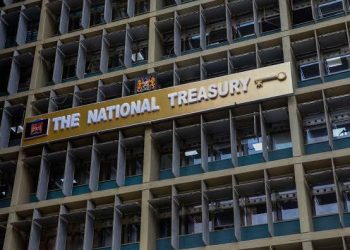
Kenya’s Treasury has acknowledged the strain in its own revised figures. Supplementary estimates for the financial year ending 30 June 2026, finalized in March 2026, project a fiscal deficit of around KSh 1.14 trillion, roughly 6% of GDP, to be financed through a mix of domestic and external borrowing.
Kenya’s delegation to the IMF and World Bank Spring Meetings in Washington, led by Treasury Cabinet Secretary John Mbadi, arrived seeking a “positive outcome” from long standing financing talks, though negotiations have been complicated by IMF concerns over potential undisclosed public debt.
The IMF has warned that elevated public debt and eroding policy buffers further heighten vulnerabilities at a moment when Kenya has little fiscal room to absorb further shocks. Whether the government can narrow the deficit without triggering renewed public discontent, following the protests over tax hikes that shook the country in mid 2024, remains the central political and economic question of 2026.