Lionel Messi’s football journey is a story of extraordinary talent, national heartbreak, redemption and a legacy that stretches far beyond the goals he has scored. Any report about his farewell must distinguish between a farewell to a particular team or stadium and his eventual retirement from international football: those are not necessarily the same moment.
For an Argentine player who spent years carrying the hopes of a football-obsessed nation, the emotional significance of a final home appearance is about more than watching a superstar play. It is an opportunity for supporters to celebrate the player who helped Argentina return to the summit of world football.
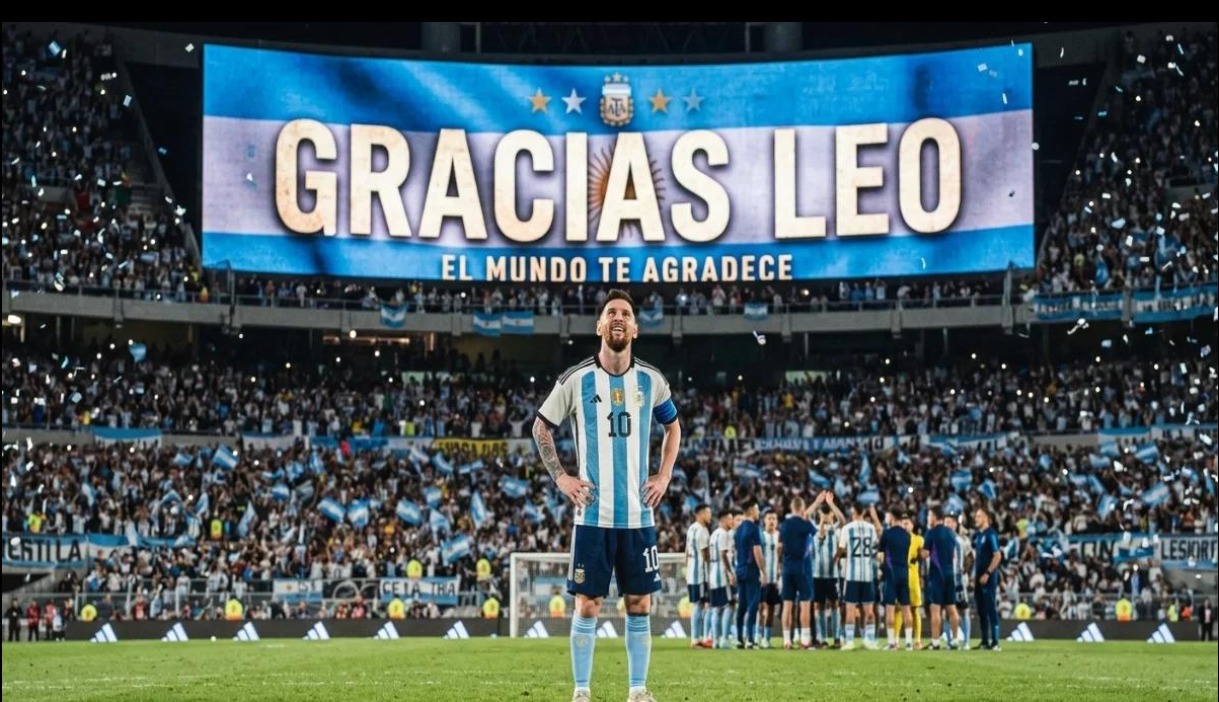
The farewell became official on 6 October 2026, when Messi played his final match for Argentina against Benin at Buenos Aires’ Monumental Stadium. Argentina won 3–0, with Nicolás Otamendi and Nicolás Paz scoring before Messi added the third goal. The match brought his 21-year international career to a close in front of approximately 85,000 supporters.
The occasion was filled with emotion long before the first whistle. As Argentina’s national anthem echoed around the stadium, Messi struggled to hold back tears. Thousands of supporters had gathered to honour a player whose career had become intertwined with the identity, pride and sporting dreams of an entire nation. At the tenth minute, the crowd rose to applaud their number 10, turning a football match into a collective expression of gratitude.


The farewell extended beyond the stadium. In Buenos Aires, landmarks were illuminated in Argentina’s sky blue and white, while supporters lined the team’s route to the venue. In Rosario, Messi’s hometown, a giant number 10 shirt bearing the word “Gracias” was unveiled. Fans spoke of sadness at losing the opportunity to watch him represent Argentina, but also of appreciation for the happiness his victories had brought a country experiencing difficult economic times.
For many supporters, Messi’s farewell was not simply the end of an international career. It was the closing chapter of a footballing story they had followed for more than two decades.
Born in Rosario, Argentina, on 24 June 1987, Messi demonstrated extraordinary footballing ability from a young age. His move to Barcelona as a teenager transformed his life, placing him in one of the world’s most demanding football environments. Yet his connection to Argentina remained central to his ambitions, even as his club career brought him international fame.
Messi made his senior international debut in August 2005, beginning a journey that would eventually make him Argentina’s most-capped player and leading goalscorer. His early years with the national team brought moments of promise, but also repeated disappointment in major tournaments.
The expectations placed on him were enormous. Argentina had a rich footballing history, shaped by icons such as Diego Maradona, and supporters wanted Messi to deliver the same defining triumphs. But for years, the comparison between the two legends became an additional burden on a player already expected to produce extraordinary performances.
Messi’s international career was not a straightforward march towards glory. Argentina lost the 2014 World Cup final to Germany, then suffered successive Copa América final defeats in 2015 and 2016. Although Messi was already celebrated worldwide for his performances at Barcelona, the absence of a major senior international trophy became a recurring criticism.
After Argentina lost the 2016 Copa América final to Chile, Messi announced his retirement from international football, only to return months later. His decision reflected the frustration of a player who wanted to win for his country but had repeatedly fallen short at the final hurdle.
Those disappointments became an important part of his legacy. They showed the difference between individual brilliance and team success, while revealing how even a player of Messi’s ability could not single-handedly guarantee a championship.
The turning point arrived in 2021, when Argentina defeated Brazil 1–0 in the Copa América final at the Maracanã. Messi finally won his first major senior international trophy, ending a 28-year wait for Argentina to win the continental championship.
That victory changed the mood around him. The player once criticised for failing to win with Argentina was now the captain who had delivered a long-awaited title. The success also strengthened the bond between Messi and a new generation of Argentine supporters who had grown up watching him pursue the trophy.
In 2022, he reached the defining moment of his career. Argentina won the FIFA World Cup in Qatar, defeating France on penalties after a dramatic 3–3 final. Messi scored twice in the final and finished the tournament with seven goals, winning the Golden Ball as its outstanding player. For Argentina, the triumph brought the country’s third men’s World Cup title and its first since 1986.
Argentina added another Copa América title in 2024, reinforcing the team’s place among international football’s leading sides. Messi had gone from a player whose international career was defined by near misses to a captain who had helped deliver the honours his country had long demanded.
His story was not without one final disappointment: Argentina reached the 2026 World Cup final but lost to Spain. Nevertheless, the defeat did not erase the achievements that had transformed his international legacy.
The 3–0 victory over Benin provided Messi with a fitting final performance. He assisted Otamendi’s opening goal, set up Nicolás Paz for the second, then scored from the penalty spot to complete the result. It was his 126th international goal, taking his final Argentina record to 208 appearances and 126 goals.
After the match, Messi addressed the crowd emotionally, reflecting on the pride of representing Argentina for more than 20 years. He described leaving the national team as deeply painful, while explaining that he felt the time had come to step away after the physical and emotional demands of the latest World Cup campaign.
Tributes came from across football. Neymar, his former Barcelona and Paris Saint-Germain teammate and longtime friend, thanked him for what he had given the sport. Argentina teammate Rodrigo De Paul spoke about Messi’s influence on him beyond football, while former teammate Ángel Di María acknowledged the emotional significance of the occasion.
The scenes at the Monumental captured what statistics alone cannot explain. Messi’s importance to Argentina was not measured only by goals, assists or trophies, but by the years of hope, frustration, belief and celebration that supporters experienced alongside him.
His journey also changed how his career will be remembered. The early criticism, the painful finals and the brief retirement announcement are now part of a larger story of perseverance and eventual triumph. Rather than escaping disappointment, Messi continued returning to the national team until he achieved the dream he had pursued since childhood.
The farewell does not necessarily mean the end of Messi’s club career. He is retiring from international football, while his future at club level remains a separate matter. But his time wearing Argentina’s famous sky-blue-and-white shirt has reached its conclusion.
For Argentina, the final image is not simply that of a great player walking off the pitch. It is that of a captain who endured years of scrutiny, helped deliver a World Cup and left as his country’s record goalscorer and most-capped player.
For more than 20 years, Argentina asked Messi to bring the dream home. At his farewell, the country asked for nothing. It simply said thank you.