

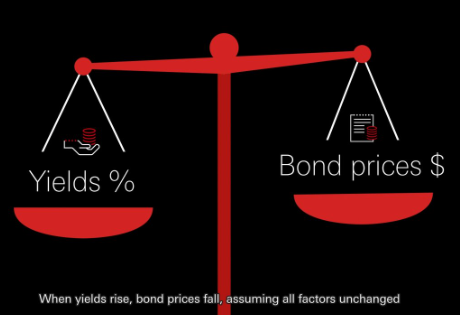
Bonds are an important component of fixed-income investment portfolios, providing investors with an opportunity to earn periodic interest income while preserving capital, subject to the issuer’s ability to meet its obligations. However, one of the fundamental concepts in bond investing is the inverse relationship between bond prices and yields. Unlike many financial assets, where higher returns may be associated with higher market values, bonds generally experience declining prices when their yields increase and rising prices when their yields decrease. Understanding this relationship is essential for evaluating bond investments, assessing market movements and making informed investment decisions.
A bond represents a debt instrument through which governments or corporations raise funds from investors for an agreed period. In return, the issuer commits to making periodic interest payments, known as coupons, and repaying the principal amount, also referred to as the face value, upon maturity. The coupon rate is usually determined at issuance and remains fixed throughout the bond’s life for conventional fixed-rate securities. However, the market price of an existing bond can fluctuate depending on prevailing interest rates, inflation expectations, credit conditions and investor demand. These changes influence the bond’s yield, which measures the return an investor expects to earn based on the purchase price, coupon payments and remaining time to maturity.
The inverse relationship between bond prices and yields is primarily driven by changes in prevailing market interest rates. When interest rates rise, newly issued bonds generally offer higher returns to attract investors. Consequently, existing bonds with lower fixed coupon rates become less attractive because investors can access newer securities offering better returns. To remain competitive, the prices of existing bonds must decline until their yields become comparable with prevailing market returns. Conversely, when market interest rates decline, newly issued bonds offer relatively lower returns, making existing bonds with higher coupon rates more attractive. Increased demand for these securities pushes their market prices upwards, resulting in lower yields for investors purchasing them at the higher prices.
For example, consider a government bond with a face value of Kshs 100,000 and an annual coupon rate of 10.0%, generating Kshs 10,000 in annual interest income. If prevailing market interest rates increase to 12.0%, newly issued comparable bonds offer higher returns than the existing security. Investors would therefore require a lower purchase price to compensate for its relatively lower coupon income. The bond may consequently trade below its face value, commonly referred to as trading at a discount. Conversely, if prevailing market interest rates decline to 8.0%, the existing bond becomes more attractive because it continues to generate annual interest income of Kshs 10,000, compared with the lower returns available on newly issued securities. Investors may therefore be willing to pay more than its face value, causing it to trade at a premium.


The relationship can also be demonstrated through yield to maturity (YTM), which represents the annualised return an investor expects to earn if the bond is purchased at its current market price and held until maturity, assuming all contractual payments are made as scheduled. YTM incorporates the purchase price, coupon payments, face value and remaining maturity period. For instance, a bond with a face value of Kshs 100,000, an annual coupon payment of Kshs 10,000 and a market price of Kshs 90,000 has a current yield of approximately 11.1%, calculated by dividing the annual coupon payment by the purchase price. If the same bond trades at Kshs 110,000, its current yield declines to approximately 9.1%. Although the coupon payment remains unchanged, the investor’s return relative to the amount invested changes with the purchase price. It is important to distinguish current yield from YTM, as current yield considers only annual coupon income relative to market price, whereas YTM also accounts for the difference between the purchase price and the amount received at maturity.
The sensitivity of bond prices to changes in yields also varies depending on the bond’s maturity and coupon rate. Generally, bonds with longer maturities are more exposed to interest rate risk because their future cash flows are discounted over a longer period. Consequently, a change in prevailing interest rates can have a more significant impact on their present value compared with shorter-term bonds of similar credit quality. Additionally, bonds with lower coupon rates generally experience greater price fluctuations than comparable securities with higher coupon rates. This is because a larger proportion of their total value is derived from payments received further into the future. Duration is therefore an important measure used by investors to assess a bond’s sensitivity to changes in interest rates.
In the bond market, these price adjustments have important implications for investment performance and portfolio management. Investors who purchase bonds at a discount may benefit from both periodic coupon income and potential capital gains if the security appreciates towards its face value as maturity approaches. However, investors who purchase bonds at a premium may experience capital losses if they hold the securities until maturity, since the issuer generally repays the original face value rather than the higher purchase price. Furthermore, investors intending to sell their bonds before maturity are exposed to market price fluctuations, meaning that rising interest rates can result in capital losses even when the issuer continues making scheduled interest payments.
It is equally important to recognise that interest rate movements are not the only factors influencing bond prices and yields. Changes in inflation expectations, government borrowing requirements, creditworthiness, liquidity conditions and economic growth prospects can also influence investor demand and the returns required to hold debt securities. For instance, an increase in perceived credit risk may cause investors to demand higher yields as compensation for the possibility of delayed payments or default. This can result in declining bond prices even when broader market interest rates remain relatively unchanged.
Ultimately, the inverse relationship between bond yields and prices reflects how investors continuously evaluate the attractiveness of existing fixed-income securities against prevailing market returns. Rising market yields generally reduce the value of existing fixed-rate bonds, while declining yields increase their attractiveness and market prices. For investors, understanding this relationship provides a useful foundation for assessing interest rate risk, comparing investment opportunities and managing fixed-income portfolios. It also highlights the importance of considering purchase prices, maturity periods, coupon rates and prevailing economic conditions when making bond investment decisions.