Yields on Kenya’s Eurobonds dropped sharply by 0.6% points with the most notable shift coming from the USD 1.0 bn 2018 Eurobond, whose yield fell to 6.86% on 26th August 2025 from 7.42% on 22nd August 2025, a decline of 0.56 percentage points after S&P Global Ratings upgraded the country’s long-term foreign currency credit rating to B from B- with outlook stable, citing improved external liquidity, resilient economic growth, and easing domestic borrowing costs, even as fiscal and debt vulnerabilities remain elevated. The move, announced on 22nd August, has lifted investor sentiment ahead of Kenya’s planned external debt refinancing in September.
The upgrade was driven primarily by an easing of external liquidity risks, strong balance of payments support, and resilience in economic activity. Kenya’s current account deficit narrowed sharply to 1.3% of GDP in 2024, down from 2.5% in 2023, as well declining to 1.6% of GDP in the twelve months to June 2025 compared to 1.8% in a similar period in 2024. This improvement was anchored by strong performances in key foreign exchange-earning sectors, particularly coffee and horticulture exports, tourism receipts, and diaspora remittances. In addition, Kenya benefited from revisions to its external sector data, which incorporated oil re-exports and updated travel receipts, providing a more comprehensive picture of the country’s inflows. These developments saw foreign exchange reserves climb to a record-high USD 11.2 bn by July 2025, up significantly from USD 6.6 bn at the end of 2023, offering an important cushion against external financing pressures.
Debt management operations also played a critical role in boosting market confidence. In February 2025, the government successfully issued a USD 1.5 bn Eurobond and simultaneously conducted a buy-back operation on part of its outstanding 2027 Eurobond. This exercise lowered near-term Eurobond principal repayments to about USD 108.0 mn annually over 2025 – 2027, down from USD 300.0 mn previously. Although participation in the tender stood at 64.0%, below initial targets, the operation smoothed Kenya’s external maturity profile and helped lower refinancing risk over the medium term.
Analysts see the rating upgrade as a vote of confidence in Kenya’s fiscal management and external debt strategy. The government has stepped up efforts to improve its debt profile, reduce refinancing risks, and stabilize public finances.


Lower yields signal stronger demand for Kenya’s bonds in the secondary market. This reduces borrowing costs for the country and provides some relief as the Treasury prepares to roll over part of its external obligations in September.
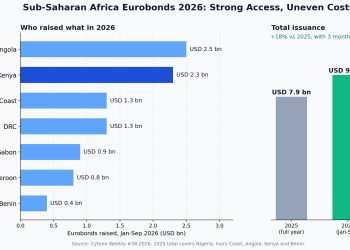
Kenya has been active in global capital markets this year, having successfully raised funds earlier to retire part of a maturing Eurobond. The upgrade and the subsequent yield decline improve the outlook for its next external debt operation.