

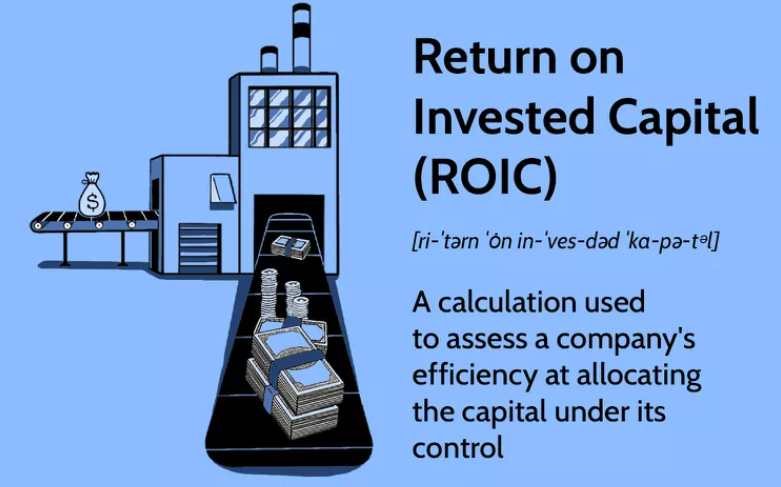
Revenue growth and rising profits are often interpreted as signs of corporate strength. However, a company can increase its earnings without necessarily improving the value it creates for shareholders. The critical question is how much additional capital is required to generate those earnings and whether the resulting returns justify the investment. Return on invested capital (ROIC) provides a framework for answering this question by measuring how efficiently a business converts the capital invested in its operations into operating profits.
ROIC evaluates the relationship between a company’s after-tax operating profit and the capital invested in its business. Unlike return on equity, which measures profitability relative to shareholders’ equity, ROIC considers capital provided by both debt and equity investors. This makes it particularly useful when comparing businesses with different capital structures, provided their operating characteristics and accounting treatments are sufficiently comparable.
The metric is commonly calculated by dividing net operating profit after tax (NOPAT) by average invested capital. NOPAT represents operating profit after tax, excluding the effects of financing decisions, while invested capital generally comprises interest-bearing debt and shareholders’ equity, adjusted for relevant non-operating assets and other balance-sheet items. Using average invested capital helps align the capital base with profits generated throughout the reporting period.
For example, consider a company generating KSh500 million in operating profit after tax with average invested capital of KSh2.5 billion. Its ROIC would be 20.0%. If a comparable business generates KSh600 million in NOPAT but employs KSh4.0 billion in invested capital, its ROIC would be 15.0%. Although the second company generates higher absolute operating profit, the first produces more operating profit for each shilling of capital employed. This distinction is important when assessing operational efficiency and the quality of growth.


The real significance of ROIC becomes clearer when it is compared with the company’s weighted average cost of capital (WACC). WACC represents the average return required by debt and equity providers, weighted according to their respective contributions to the company’s financing. When ROIC exceeds WACC, the company is generally creating economic value because its operating returns exceed the cost of the capital deployed. When ROIC falls below WACC, the company may be destroying value, even if revenue and accounting profits continue to increase.
For instance, a business with an ROIC of 18.0% and a WACC of 12.0% generates a positive return spread of 6.0 percentage points. If it can reinvest additional capital at comparable returns, expansion has the potential to create further value. Conversely, a business earning 8.0% on invested capital against a WACC of 12.0% faces a negative return spread. Expanding such a business may increase its size while weakening its economic performance, unless the additional investment improves operating efficiency or raises future returns.
This relationship makes ROIC particularly useful when evaluating management’s capital-allocation decisions. Companies regularly choose between expanding production capacity, entering new markets, acquiring competitors, investing in technology, reducing debt, and returning cash to shareholders. The appropriate decision depends partly on the expected returns from each alternative. A company with attractive reinvestment opportunities may create more value by retaining earnings, while a business with limited opportunities to earn returns above its cost of capital may be better positioned to distribute excess cash.
ROIC can also help analysts identify competitive advantages. Businesses with durable brands, efficient operating models, strong distribution networks, proprietary technology, or significant switching costs may sustain high returns on capital over extended periods. These advantages can allow companies to generate attractive operating profits without requiring proportionate increases in their capital base. However, elevated ROIC should not automatically be interpreted as evidence of a durable competitive advantage. Temporary pricing power, favourable commodity cycles, asset disposals, and unusually low investment requirements can also influence the metric.
Comparisons across industries therefore require careful interpretation. Banks, insurers, manufacturers, retailers, and technology businesses operate with different balance-sheet structures and capital requirements. For financial institutions, deposits and other operating liabilities are integral to the business model, making conventional ROIC calculations less straightforward than for non-financial companies. Analysts evaluating banks may obtain more meaningful insights from measures such as return on equity, return on assets, net interest margin, and regulatory capital efficiency.
Another consideration is that accounting figures may not fully capture the economic capital employed by a business. Internally developed brands, research capabilities, and certain intangible assets may not be recognised in the balance sheet in the same way as acquired assets. This can make reported ROIC appear unusually high for businesses that have built valuable intangible assets internally. Differences in depreciation policies, acquisition accounting, and asset age can also complicate comparisons between companies.
For valuation purposes, ROIC provides a useful link between a company’s operating performance and its long-term growth potential. Growth creates value most effectively when businesses can reinvest capital at returns above their cost of capital. Consequently, analysts should assess ROIC alongside revenue growth, operating margins, reinvestment requirements, cash-flow generation, and the sustainability of competitive advantages. A company with moderate growth and consistently high incremental returns on capital may create more economic value than a faster-growing competitor that requires substantial investment to generate relatively weak returns.
Ultimately, ROIC shifts investment analysis beyond the question of how much profit a company generates to examine how efficiently it uses the resources entrusted to it. By comparing operating returns with the cost of capital, analysts can distinguish between growth that expands economic value and growth that merely increases the size of a business. For investors, this distinction is essential when evaluating management effectiveness, assessing long-term earnings potential, and determining whether a company’s growth strategy is likely to translate into sustainable shareholder value.