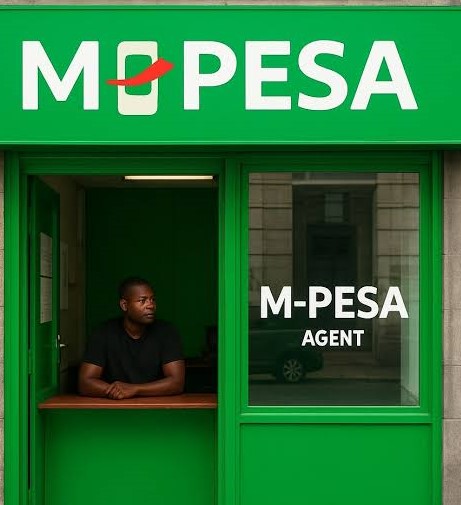
Kenya’s mobile money ecosystem continues to expand as digital payments become increasingly embedded in everyday transactions. However, the rapid growth in the number of M-Pesa agents is creating a more competitive operating environment, reducing the average commission earned by individual outlets. Although transaction volumes and mobile money revenues continue to reach new highs, the increase in agent numbers means commission income is being shared across a much larger network. As a result, many agents are diversifying their businesses by offering agency banking, additional mobile money services and other financial products to maintain sustainable earnings.
According to Safaricom’s FY2026 Annual Report, the number of M-Pesa agents increased by 11.4% to 333,011 in the year ended March 2026 from 298,890 in March 2025. Over the same period, total commissions paid to agents increased marginally by 0.3% to KShs 37.4 bn from KShs 37.3 bn. Because commission growth did not keep pace with the expansion in the agent network, the average annual commission earned per agent declined by 10.0% to KShs 112,244 from KShs 124,720. This translates to average monthly earnings of approximately KShs 9,353 per outlet, highlighting the growing competition among agents despite the continued expansion of mobile money services.
The decline in average commission earnings comes even as M-Pesa continues to record strong business growth. Safaricom reported that the platform now serves 40.7 million customers and processes more than 136.0 million transactions every day. During the financial year ended March 2026, the platform processed transactions valued at KShs 41.7 tn, reinforcing its position as the country’s dominant digital payments platform. At the same time, M-Pesa revenue increased by 13.4% to KShs 182.74 bn from KShs 161.10 bn, demonstrating that mobile money remains one of Safaricom’s most important sources of revenue.
The changing nature of digital payments is also reshaping the business model of M-Pesa agents. As consumers increasingly pay merchants directly using Lipa na M-Pesa and Pochi la Biashara, fewer customers are visiting agent outlets to withdraw cash. This shift is reflected in the strong growth of merchant payment solutions. During the year ended March 2026, Lipa na M-Pesa revenue increased by 21.7% to KShs 9.3 bn from KShs 7.6 bn, while Pochi la Biashara revenue rose by 86.0% to KShs 4.0 bn from KShs 2.2 bn. The continued migration toward digital merchant payments is gradually reducing the importance of traditional cash-based transactions, encouraging agents to seek alternative sources of income.

In response, many M-Pesa agents are broadening their service offerings to remain competitive. A growing number now provide agency banking services for financial institutions such as Equity Bank, KCB Bank and Co-operative Bank, enabling customers to access banking services alongside mobile money transactions. Others have expanded to operate both M-Pesa and Airtel Money outlets, allowing them to serve a wider customer base and diversify their revenue streams. These additional services help offset the decline in average commission income while strengthening the role of agent outlets as broader financial service centres.
Overall, Kenya’s expanding mobile money ecosystem continues to support strong growth in digital payments, but increasing competition among M-Pesa agents is placing pressure on individual commission earnings. With the agent network growing to 333,011 outlets while average annual commissions declined to KShs 112,244, future profitability is likely to depend on diversification rather than traditional cash deposit and withdrawal services. As digital payments continue to evolve, agents that offer a wider range of financial services are expected to be better positioned to adapt to the changing dynamics of Kenya’s digital financial ecosystem