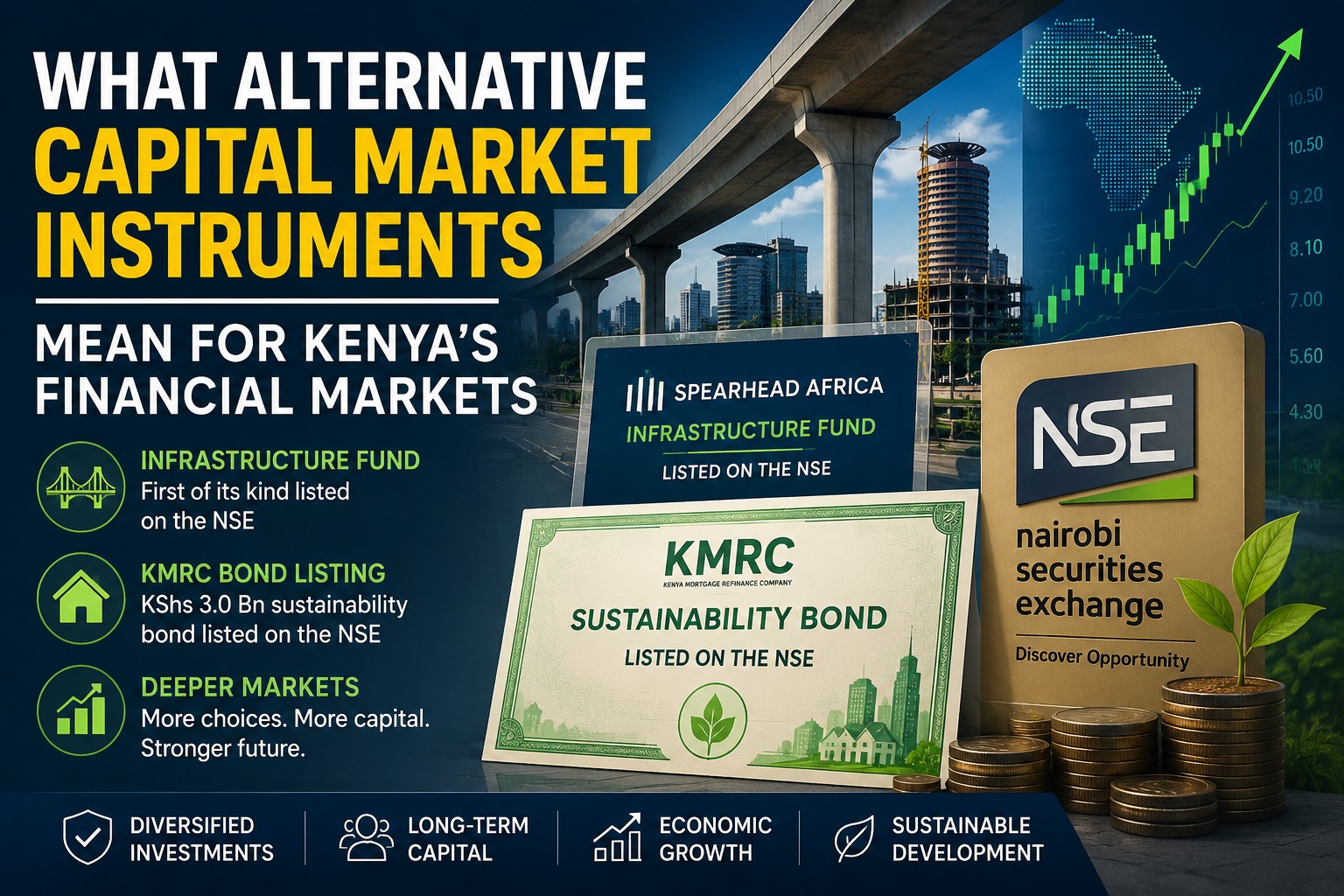
Kenya’s capital markets are increasingly undergoing a structural transformation, marked by the emergence of alternative investment instruments beyond traditional equities and government securities. Recent developments, including the listing of Kenya’s first infrastructure fund on the Nairobi Securities Exchange (NSE) and the successful listing of the Kenya Mortgage Refinance Company (KMRC) sustainability bond, signal a gradual deepening of the country’s financial markets and a shift toward more diversified long-term financing solutions.
A major milestone was achieved in May 2026 when Spearhead Africa Asset Management listed the Spearhead Africa Infrastructure Fund (SAIF), becoming the first infrastructure fund to trade on the NSE. The fund raised Kshs 3.4 bn through its initial public offer and introduced infrastructure debt as a tradable asset class accessible through public markets. SAIF is expected to channel capital into sectors such as renewable energy, digital infrastructure, logistics, and electrification across East Africa.
Similarly, KMRC recently listed a Kshs 3.0 bn sustainability bond on the NSE, attracting applications worth Kshs 9.4 bn, translating to an oversubscription rate of 313.0%. The proceeds will primarily support affordable housing and green housing projects, reflecting growing investor appetite for thematic and impact-focused securities.
These developments are significant because they expand Kenya’s investment landscape beyond conventional stocks and Treasury securities, introducing instruments tailored toward infrastructure financing, housing development, and sustainability-linked investments. Historically, infrastructure and housing projects in Kenya have relied heavily on bank lending and external sovereign borrowing, exposing the economy to elevated borrowing costs, refinancing risks, and foreign exchange pressures. Alternative capital market instruments provide an avenue for mobilizing long-term domestic capital from institutional investors such as pension funds, insurance companies, and asset managers. Kenya’s pension industry alone manages more than Kshs 2.8 tn in assets, creating substantial potential for long-term infrastructure financing through capital markets.

The growing use of these instruments also enhances financial market sophistication by introducing new asset classes that improve portfolio diversification, liquidity, and investor participation. Infrastructure funds, sustainability bonds, green notes, and asset-backed securities provide investors with exposure to sectors that were previously difficult to access through public markets. This transition mirrors global capital market trends where thematic and alternative investments are increasingly becoming critical sources of development financing.
Moreover, the rise of alternative financing structures could reduce Kenya’s overreliance on public debt-financed infrastructure development at a time when fiscal pressures and debt servicing costs remain elevated. The government has already signaled support for infrastructure-focused investment vehicles as part of broader efforts to mobilize private capital into strategic sectors without significantly expanding sovereign borrowing.
Despite the progress, challenges remain. Kenya’s secondary market still faces liquidity constraints, limited retail investor participation, and relatively low financial literacy around complex investment products. In addition, the success of alternative instruments will depend on strong regulatory oversight, transparency, and consistent project performance to sustain investor confidence.
Nevertheless, the recent listings indicate that Kenya’s capital markets are gradually evolving from a predominantly equity- and government bond-driven market into a more diversified financial ecosystem capable of supporting long-term economic development. If successfully scaled, alternative capital market instruments could play a critical role in financing infrastructure, housing, and sustainable development while strengthening the depth, resilience, and competitiveness of Kenya’s financial markets.
Start your investment journey today with the Cytonn Money Market Fund. Call + 254 (0)709101200 or email sales@cytonn.com