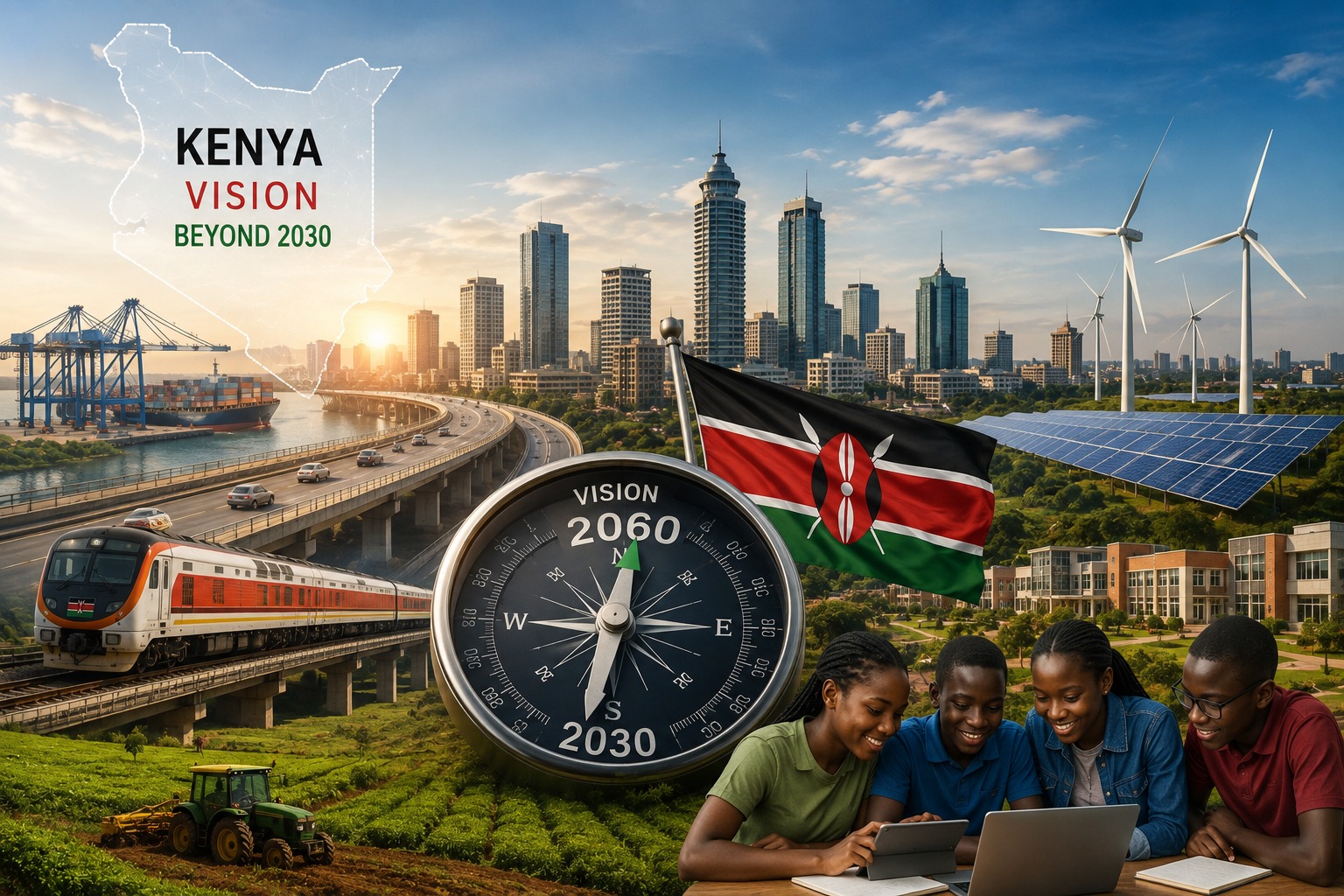
Kenya is beginning a new chapter in its long-term development planning as the country starts the process of developing a national vision beyond Vision 2030. The national conversation, officially launched in August 2026, seeks to assess the progress and gaps of Vision 2030 and develop a new 30-year blueprint that will guide Kenya’s development towards 2060. The proposed Vision 2060 is expected to build on the foundations already established while addressing challenges that have emerged from rapid technological, demographic, environmental and economic change.
Vision 2030, launched in 2008, was built around three pillars, Economic, Social and Political, with the ambition of transforming Kenya into a newly industrializing, middle-income country with a high quality of life. Over its implementation period, Kenya has made significant progress in areas including transport infrastructure, energy, ICT and financial services, while devolution has fundamentally changed the delivery of public services and resource allocation. However, the country’s development trajectory has also highlighted persistent challenges, including low productivity, limited industrialization, unemployment, inequality, fiscal constraints and uneven access to quality public services. The government’s current review of Vision 2030 specifically seeks to identify these gaps and determine how they can be addressed in the next long-term plan.
The proposed Vision 2060 therefore arrives at a fundamentally different economic landscape. Technology and artificial intelligence are transforming the nature of work and competitiveness, climate change is increasing pressure on agriculture and water resources, while demographic growth will require millions of new jobs and greater investment in human capital. The government has indicated that the new vision will place greater emphasis on innovation, artificial intelligence, climate action, the digital economy, green manufacturing, the blue economy and agribusiness, alongside social priorities such as healthcare, education, housing, water and sanitation.
However, perhaps the biggest lesson from Vision 2030 is that having a long-term plan is not the same as achieving long-term transformation. Kenya has produced numerous development strategies and medium-term plans, but implementation has often been affected by changing priorities, financing constraints and limited coordination across government. The State Department for Economic Planning has itself identified fragmented planning and weak institutionalization as structural challenges to effective economic transformation. The new vision will therefore need more than ambitious targets; it will require measurable outcomes, clear accountability and a credible implementation framework that survives changes in political administration.


Financing will be equally important. Transforming Kenya’s infrastructure, energy systems, manufacturing base, healthcare and human capital will require substantial long-term investment. The new development framework will therefore need to consider how to mobilize domestic savings, private-sector investment and foreign capital without placing excessive pressure on public finances. This makes the development of deeper capital markets, stronger public-private partnerships and commercially viable infrastructure investment particularly important.
Most importantly, Vision 2060 should not simply be a government document. The ongoing national conversation is intended to involve citizens, the private sector, civil society, academia and other stakeholders across the country. This is critical because a 30-year development strategy must command broad ownership if it is to survive political and economic cycles.
Ultimately, the success of Vision 2060 will not be determined by how ambitious its targets are, but by whether Kenya can build the institutions, financing mechanisms and implementation discipline required to achieve them. Vision 2030 provided the blueprint; Vision 2060 must provide a stronger mechanism for turning long-term ambition into measurable transformation. The real question is therefore not what Kenya wants to become by 2060, but whether it can maintain the consistency required to get there.
Start your investment journey today with the Cytonn Money Market Fund. Call + 254 (0)709101200 or email sales@cytonn.com