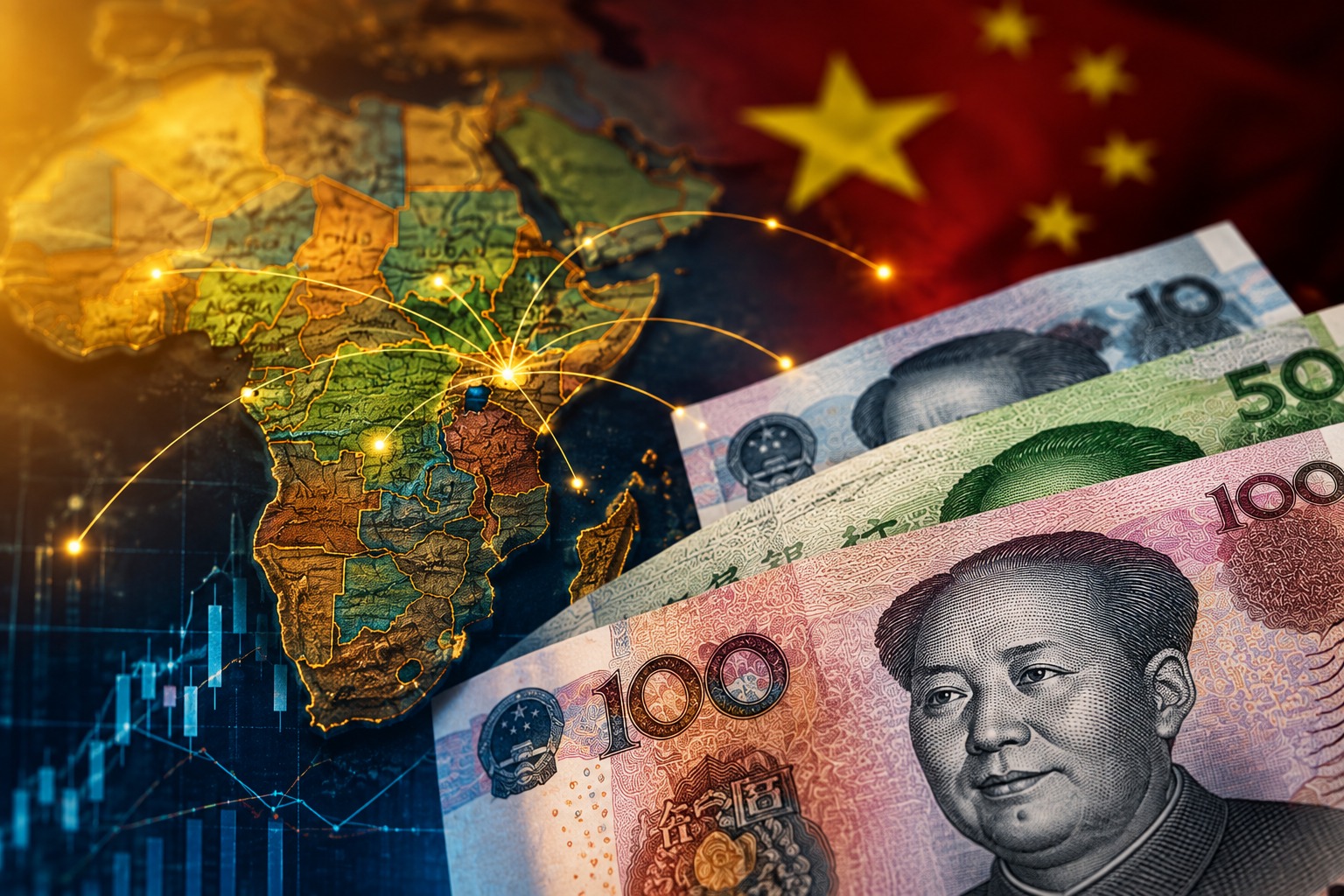
The People’s Bank of China’s (PBoC) recent decision to authorize Standard Bank and the Industrial and Commercial Bank of China (ICBC) as the Renminbi (RMB) Clearing Bank of Africa represents another milestone in the internationalization of the Chinese Yuan. While the announcement centers on cross-border payment infrastructure, its broader significance lies in what it reveals about the evolving financial relationship between Africa and China. As Beijing seeks to expand the global use of the Yuan, Africa is emerging as an increasingly important frontier, with the currency gradually becoming embedded in trade, sovereign financing and capital markets.
China has been Africa’s largest bilateral trading partner for more than a decade, yet much of the trade between the two has traditionally been invoiced and settled in US dollars. This has required African businesses to convert local currencies into dollars before paying Chinese suppliers, increasing transaction costs, exposing firms to exchange rate volatility and creating dependence on dollar liquidity. Direct RMB clearing addresses these inefficiencies by enabling financial institutions to settle transactions directly in Yuan through China’s domestic payment infrastructure. The new clearing arrangement, which will initially serve 19 African countries, is expected to improve settlement efficiency, reduce foreign exchange conversion costs and strengthen the financial infrastructure supporting China-Africa trade.
The development also reflects a broader shift in China’s financing strategy across Africa. According to Boston University’s Global Development Policy Center Chinese Loans to Africa Database, Chinese loan commitments to the continent declined to USD 2.1 bn in 2024, down from USD 3.9 bn in 2023 and well below the USD 28.8 bn peak recorded in 2016. Rather than signaling a retreat, however, this points to a strategic reorientation. Chinese lenders are increasingly moving away from financing large infrastructure projects toward commercially viable investments with stronger repayment prospects, while encouraging greater use of the Yuan in cross-border lending. This supports Beijing’s long-term objective of reducing reliance on the US dollar and strengthening the RMB’s role in international finance.
Kenya provides one of the clearest examples of this transition. In October 2025, the National Treasury announced the restructuring of three Standard Gauge Railway (SGR) loans from the Export-Import Bank of China, converting approximately USD 3.5 bn of outstanding debt from US dollars into Renminbi while extending repayment maturities and grace periods. The Treasury estimates that the restructuring will reduce annual debt-servicing costs by approximately USD 215 mn. Although analysts note that much of the savings arise from the improved financing terms rather than the currency conversion alone, the transaction nevertheless illustrates China’s increasing willingness to finance and restructure overseas lending in its own currency.


The Yuan’s expanding role is also evident in Africa’s capital markets and reserve management. Egypt became the first African sovereign to issue a Panda Bond in China’s domestic bond market, providing an alternative source of external financing beyond Eurobonds. Nigeria has maintained a bilateral currency swap agreement with China to facilitate trade settlement in local currencies, while several African central banks, including those of South Africa, Nigeria, Tanzania and the Democratic Republic of the Congo, have incorporated the Yuan into their foreign exchange reserve portfolios. These developments demonstrate that the RMB is expanding through multiple channels, including trade settlement, sovereign borrowing, capital markets and reserve diversification.
The Yuan’s growing presence in Africa should not be viewed as signaling the decline of the US dollar. The dollar continues to dominate global reserves, commodity pricing and international capital markets, supported by the depth and liquidity of US financial markets. Instead, Africa appears to be moving towards a more diversified currency ecosystem in which the Yuan complements rather than replaces the dollar. For African economies, this presents opportunities to lower transaction costs, diversify funding sources and deepen financial ties with China, but it also requires prudent debt management and effective foreign exchange risk management.
Ultimately, the significance of the PBoC’s latest decision extends beyond the designation of a new clearing bank. It reflects the gradual emergence of a more multipolar international monetary system in which the Yuan is assuming a larger role alongside the US dollar. As trade and investment links between Africa and China continue to deepen, the expansion of RMB clearing infrastructure, Yuan-denominated financing and alternative capital market instruments is likely to reshape the continent’s financial landscape. How African economies manage this transition will determine whether the growing role of the Yuan strengthens financial resilience and economic integration or creates new forms of external dependence.
Start your investment journey today with the Cytonn Money Market Fund. Call + 254 (0)709101200 or email sales@cytonn.com