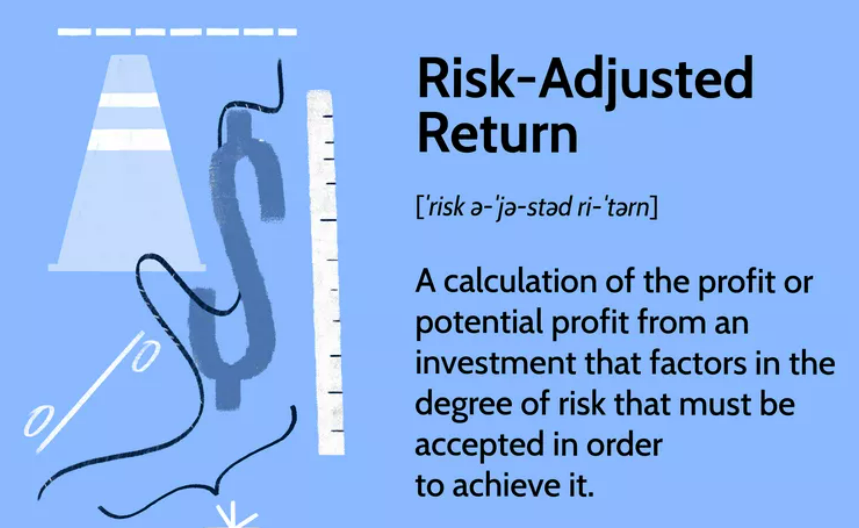
When assessing investment performance, many investors focus primarily on returns. While returns are an important measure of success, they do not provide a complete picture of an investment’s effectiveness. A more comprehensive evaluation considers not only the returns generated but also the level of risk undertaken to achieve those returns. This concept is known as risk-adjusted return, and it plays a critical role in investment decision-making.
Risk-adjusted returns help investors determine whether the rewards from an investment adequately compensate for the risks involved. Two investments may generate similar returns, but if one carries significantly higher volatility or uncertainty, it may not necessarily be the superior choice. By incorporating risk into performance evaluation, investors gain a more accurate understanding of the true value of an investment strategy.
One of the primary reasons risk-adjusted returns are important is that financial markets are inherently uncertain. Economic conditions, interest rates, inflation, geopolitical developments, and company-specific events can all affect asset prices. Investors who focus solely on returns may overlook the possibility that those gains were achieved through excessive risk-taking, which may not be sustainable over the long term.
Risk-adjusted performance measures also support better portfolio management. Diversification aims to reduce portfolio risk while maintaining expected returns. By evaluating investments through a risk-adjusted lens, investors can identify assets that contribute positively to portfolio efficiency. This approach helps build portfolios that seek to maximize returns for a given level of risk.


Institutional investors, including pension funds, insurance companies, and asset managers, frequently use risk-adjusted metrics to evaluate fund managers and investment strategies. Measures such as the Sharpe Ratio, Treynor Ratio, and Sortino Ratio are commonly used to assess how effectively returns have been generated relative to risk exposure. These metrics provide a standardized framework for comparing investment performance across different asset classes and strategies.
Risk-adjusted returns are particularly important during periods of market volatility. In uncertain market environments, investments that preserve capital and maintain relatively stable returns may outperform higher-risk assets on a risk-adjusted basis. This highlights the importance of consistency rather than simply pursuing the highest possible returns.
The concept also influences asset allocation decisions. Investors with different risk tolerances may prioritize investments that align with their financial objectives and capacity to absorb losses. For example, a conservative investor may prefer lower but more stable risk-adjusted returns, while an aggressive investor may accept greater volatility in pursuit of higher long-term growth.
Technology and data analytics have enhanced the ability of investors to assess risk-adjusted performance. Modern portfolio management systems can evaluate multiple risk factors, simulate market scenarios, and provide detailed insights into portfolio efficiency. These tools support more informed investment decisions and improve risk management practices.
However, risk-adjusted performance measures are not without limitations. Historical data may not always predict future outcomes, and certain risks may be difficult to quantify. As a result, investors should use risk-adjusted metrics alongside broader qualitative and quantitative analysis rather than relying on them exclusively.
In conclusion, risk-adjusted returns provide a more complete framework for evaluating investment performance than returns alone. By considering both reward and risk, investors can make more informed decisions, improve portfolio construction, and pursue sustainable long-term investment outcomes. In an increasingly complex financial environment, understanding risk-adjusted returns remains essential for effective investment management.