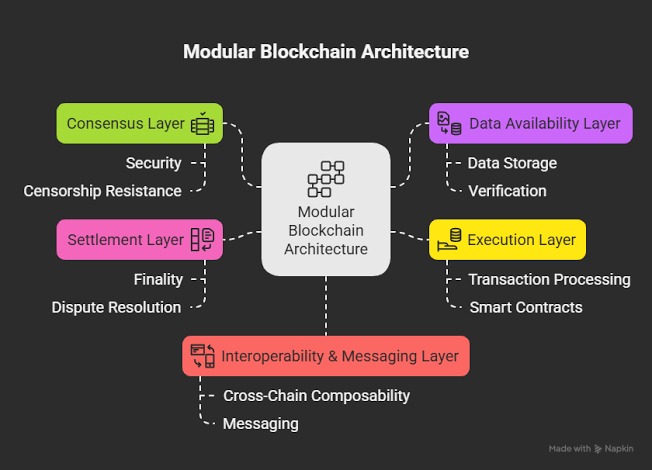
The way early blockchains were built created a massive speed problem. However, the tech industry is finally fixing this issue today. In the beginning, networks like Bitcoin and Ethereum were built as monolithic systems. This setup meant that one single network had to do every single job at the same time. For example, the network had to process the transaction, double-check that nobody was cheating, and store the history forever. Consequently, when millions of people tried to use the network at once, the system would get completely clogged up. This congestion caused transaction fees to skyrocket. Thus, it made the apps unusable for normal everyday payments. To fix this bottleneck, engineers started breaking the blockchain apart into specialized, independent layers that work together like an assembly line. This new setup is called modular blockchain architecture, and it completely changes how digital networks scale up.
Assigning Specific Network Tasks to Independent Layers
Instead of making one network do everything, different layers are assigned to do just one specific job really well. For instance, a specialized top layer called a rollup handles the speed part by processing thousands of transactions outside the main network in just a split second. Once it finishes processing them, it compresses all that data into a neat little package. Then, it passes it down to a separate baseline layer to be stored safely. Because the heavy computing work is separated from the storage work, the whole system runs incredibly fast. Therefore, this separation drops transaction costs down to less than a penny.
How Celestia Solves the Data Availability Bottleneck
A perfect example of this teamwork strategy in action within modular blockchain architecture is a network called Celestia, which launched its mainnet in late 2023. Celestia was built from the ground up to do only one job really well. Specifically, it makes sure transaction data is organized and available for anyone who needs to verify it. It does not run apps or calculate balances. Instead, it just acts as a high-speed data highway for other networks to lean on. By using a clever math trick, it lets small computers verify data blocks without downloading the whole file. Consequently, it can support hundreds of separate speed layers at the same time without slowing down.
Streamlining Network Deployment with Specialized Toolkits
Because this modular approach works so well, it has quickly become the gold standard for creating new blockchain networks. Major development tools like Arbitrum Orbit, the OP Stack, and the Polygon Chain Development Kit have completely built this design into their systems. Now, instead of spending months trying to build a secure network from scratch, a company can launch its own custom, high-speed blockchain in just a few days. They achieve this speed by plugging directly into these existing specialized layers. This structural flexibility allows new platforms to easily handle thousands of transactions per second without breaking a sweat.


The Evolution Away from Legacy Monolithic Frameworks
Ultimately, modular blockchain architecture is on track to completely replace the old, slow way of building blockchains. As transaction costs drop so low that people don’t even notice them, the technology will finally be ready to power everyday microtransactions and global digital apps at a massive scale. For analysts and developers looking at the market today, the winners won’t be the giant single networks of the past. Instead, the market will favor the specialized platforms that connect together most efficiently to keep transactions fast, cheap, and simple.