
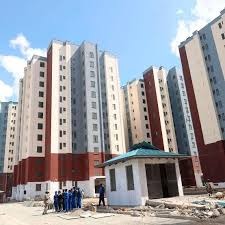
Kenya’s real estate landscape is undergoing a significant transformation. For the first time in over a decade, private property developers are deliberately shifting their investment portfolios away from residential housing and toward commercial properties—warehouses, office spaces, and retail centres. This strategic reorientation reveals far more than simple market fluctuations; it reflects the widening gap between government policy ambitions and private sector realities.
The Numbers Tell a Stark Story
Recent data from the Kenya National Bureau of Statistics paints a compelling picture of this market realignment. In the first quarter of 2026, the value of approved commercial building plans in Nairobi surged 44.4 percent to Sh21.37 billion, up from Sh14.8 billion in the same period last year. Conversely, residential property approvals declined by 10.3 percent, falling from Sh45.77 billion to Sh41.06 billion. What’s particularly striking is the share of commercial projects in the total Nairobi construction pipeline: it has climbed from just 9.3 percent in Q1 2023 to 34.2 percent in Q1 2026—a shift that underscores not merely a trend but a fundamental rebalancing of investor priorities.
While the overall value of approved building plans in Nairobi grew modestly by 3.1 percent to Sh62.44 billion, the composition of that growth has changed dramatically. Developers are increasingly betting on commercial properties, recognizing where market opportunity—and market risk—actually lie.
Government Doubles Down on Affordable Housing
Parallel to this private-sector shift, the government has dramatically accelerated its affordable housing push. President William Ruto’s Affordable Housing Programme has become one of the fastest-growing areas of public expenditure since the housing levy’s introduction in July 2023. Government spending on housing nearly tripled to Sh79.03 billion in the financial year ended June 2025, compared to just Sh25.49 billion a year earlier. This represents a nine-fold increase from the Sh9.13 billion spent in 2022/23, before the levy came into force.


Treasury Cabinet Secretary John Mbadi framed the initiative in his June 2026 budget speech as essential infrastructure for social stability. The government has registered over one million applications on the Boma Yangu platform and claims to have either completed or placed under implementation 277,281 housing units nationwide. These figures underscore a strategic government commitment to reshape Kenya’s housing market from the top down.
Why Are Private Developers Walking Away?
The divergence between government ambition and private sector behaviour deserves scrutiny. Developers aren’t abandoning residential real estate out of philanthropy or indifference—they’re responding to economic pressures that make residential housing an increasingly unpalatable investment proposition.
Cost and Access Constraints: Construction costs remain elevated, driven by imported materials and labour expenses. Simultaneously, developers face expensive financing options and rising project timelines—all while household purchasing power remains constrained. In this environment, the residential market offers thin margins and extended capital recovery cycles.
Government Competition: When the state enters a market with subsidised housing programmes and direct spending power, it inevitably displaces private activity. Developers cannot compete with government subsidies on price, and the Affordable Housing Programme’s scale makes direct competition futile. Rather than fight for scraps, developers have logically redirected capital to markets where government isn’t the dominant player.
Commercial Sector Opportunity: Kenya’s commercial real estate sector—offices, industrial parks, warehouses, and modern retail—remains undersupplied relative to demand. Businesses seeking Grade-A office space and logistics facilities face limited options. Returns on commercial properties are often more predictable and demand is less price-sensitive, making this segment far more attractive in the current macroeconomic climate.
A Market in Transition, Not Crisis
This shift should not be interpreted as market failure or crisis. Rather, it represents rational capital allocation in response to changing incentive structures. The decline in residential housing approvals is modest—10.3 percent—and comes against a backdrop of strong absolute spending by government. The total approved Nairobi construction pipeline remains robust at Sh62.44 billion, the highest level since Q1 2023.
What the data does reveal is that Kenya’s affordable housing agenda has successfully influenced private sector behaviour—by ceding residential space to government and pursuing commercial alternatives. Whether this division of labour benefits Kenyans long-term depends on two variables: the quality and efficiency of government housing delivery, and whether commercial real estate development catalyses broader economic activity and job creation.
What Comes Next?
As Kenya’s real estate market continues to rebalance, several questions merit attention. Will government maintain investment momentum and deliver promised housing units on budget and timeline? Can commercial real estate development outpace residential decline and drive GDP growth? And most critically: will the housing market serve all Kenyans, or will the bifurcation between government-delivered and private-commercial spaces deepen inequality?
For now, the numbers suggest Kenya’s real estate market is evolving—not breaking. But that evolution will define housing affordability and economic opportunity for millions for years to come.
This commentary is based on original reporting by Constant Munda, published in Business Daily, titled “Developers go commercial as State deepens housing push.” Data cited reflects Kenya National Bureau of Statistics (KNBS) figures for Q1 2026 and the 2026 Economic Survey, as reported in the original article.