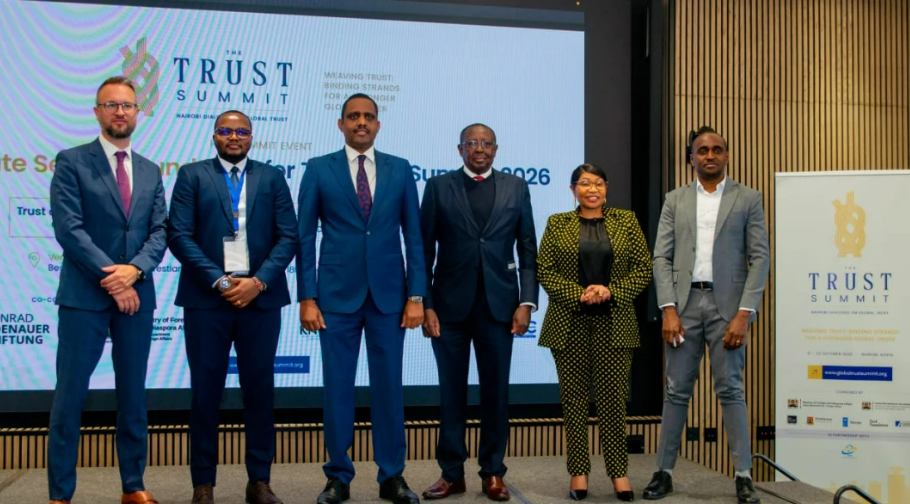
Kenya will host the inaugural Trust Summit: Nairobi Dialogues on Global Trust from 21–23 October 2026, bringing together government representatives, business leaders, academics, civil society and other stakeholders. The summit will focus on the theme Weaving Trust: Binding Strands for a Stronger Global Order and examine the relationship between institutional trust, governance, economic activity and investment. The event comes as confidence in several public institutions remains relatively weak, highlighting the economic implications of trust for businesses and investors. The summit is expected to advance initiatives such as a Regional Regulatory Trust Index, which could provide a mechanism for tracking institutional confidence and regulatory performance over time.
Recent surveys illustrate the scale of the trust challenge. Afro barometer found that 45.0% of Kenyans expressed trust in the President, down from 72.0% in 2014, while 44.0% trusted Parliament. Trust in the police and electoral commission stood at 36.0% each. The 2025 Edelman Trust Barometer also placed trust in Kenya’s government at 38.0%, a four-percentage-point decline from the previous year. At the same time, business remained considerably more trusted, with 72.0% of Kenyans expressing trust in businesses. These differences matter for investors because perceptions of institutional credibility can influence assessments of regulatory, political and operational risks.
Weak institutional trust can increase the cost of doing business and accessing capital. Companies operating in uncertain environments may allocate more resources to contracts, audits, compliance, security and other measures that reduce operational risks. Kenya’s private sector has recently linked the trust deficit to higher borrowing costs, increased compliance expenses and slower investment flows. Research cited in the Trust Summit’s discussions estimates that African countries incur approximately USD 75.0 billion annually in additional interest costs through risk premiums associated with perceptions of institutional weakness. Higher risk premiums can affect both public and private borrowers by increasing financing costs and reducing the capital available for productive investment.
Institutional confidence also affects foreign direct investment (FDI). Long-term investors in infrastructure, manufacturing, real estate and other capital-intensive sectors typically require predictable regulations, transparent decision-making and reliable contract enforcement. Where these conditions remain uncertain, investors may demand higher returns to compensate for additional risks or allocate capital to markets with stronger institutional frameworks. The World Bank notes that effective institutions support investment, infrastructure development, businesses and job creation, making governance quality an important component of the broader investment environment.


The Trust Summit could therefore have implications beyond governance by creating a platform for improving regulatory predictability and investor confidence. Its proposed outcomes include the Nairobi Declaration on Trust for Sustainable Development and Peace, the Regional Regulatory Trust Index and a Global Trust Council to support continued monitoring and follow-up. If these initiatives translate into measurable improvements in transparency, accountability and regulatory consistency, they could help reduce perceived investment risk over time.
For investors, the key consideration will be whether the summit produces measurable institutional improvements rather than short-term commitments. Stronger trust could reduce transaction costs, improve policy predictability and support more efficient allocation of capital. Conversely, persistent institutional uncertainty could continue to increase risk premiums and limit investment flows. Kenya’s ability to attract and retain long-term domestic and international capital will therefore depend not only on economic growth and market opportunities, but also on the credibility, transparency and effectiveness of the institutions that govern those opportunities.