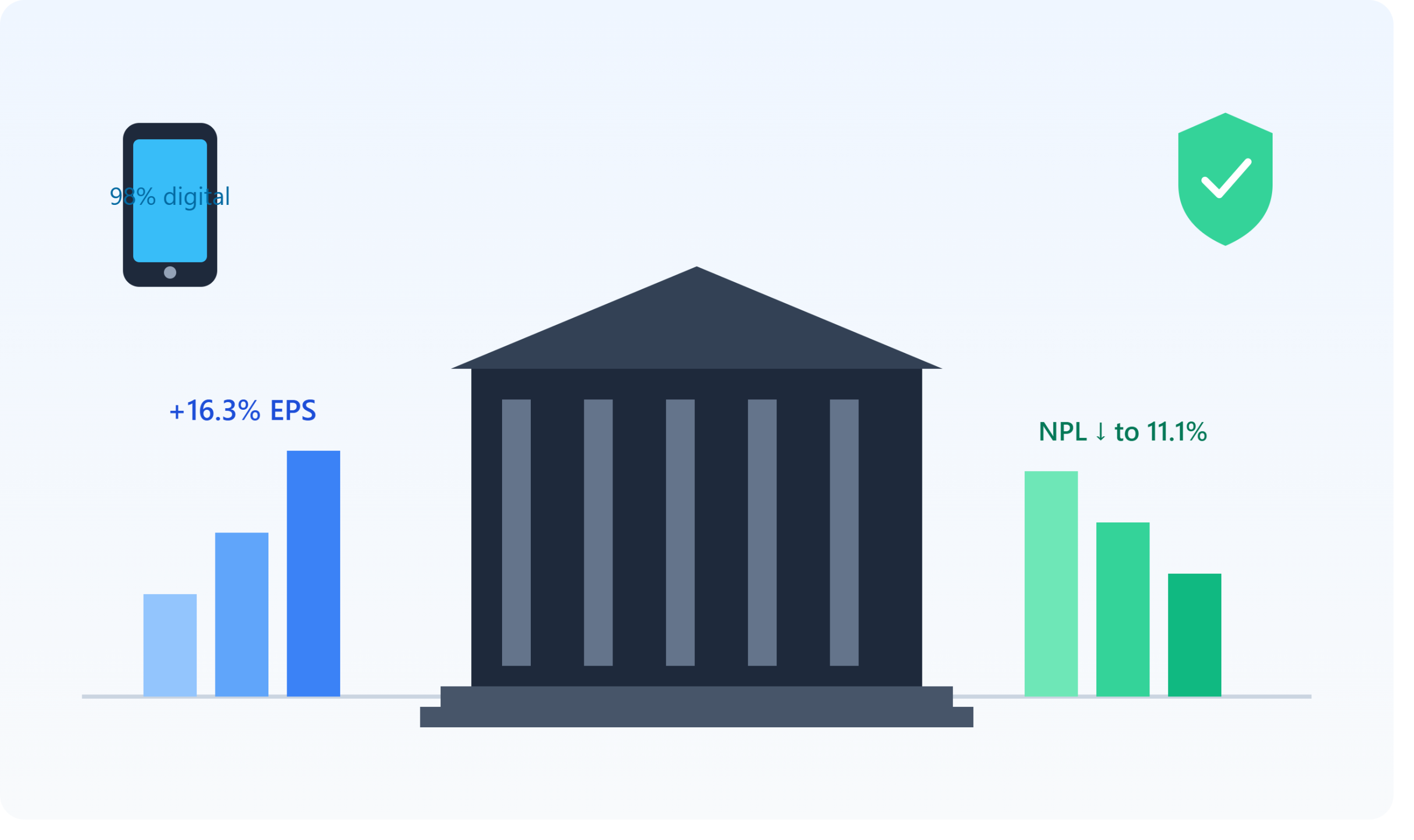
Kenya’s listed banks just closed out the first half of 2026 with their strongest earnings growth in years, and the story behind the numbers is less about interest rates and more about how much banks are now earning from everything else they do. Core earnings per share across the eleven listed banks grew by a weighted 16.3% in H1’2026, roughly double the 8.4% growth recorded over the same period in 2025. The engine behind that jump was non-funded income, which grew 14.6% after actually declining 5.8% a year earlier, driven mainly by a surge in fees and commissions on loans as banks lean less on interest income and more on transaction-based revenue.
A big part of that shift traces back to digitization, which kept reshaping how Kenyans bank throughout the first half of the year. Equity Group reported that 89.7% of its transactions were processed through digital platforms, with 98.3% happening entirely outside physical branches, while KCB Group said 98.0% of its transactions by number now happen away from the counter. PesaLink, the instant account-to-account payment rail linking Kenyan banks, extended its reach further by partnering with the Pan-African Payment and Settlement System in February, connecting more than 80 PesaLink participants to over 160 banks across the continent for instant, 24/7 cross-border payments in local currencies. Pricing on PesaLink also shifted mid-year, with DTB and later KCB introducing a flat Kshs 20 fee on transfers above Kshs 1,000, while smaller transfers stayed free.
Regulation was busy too. The Central Bank of Kenya overhauled its decades-old banking fee structure in May, replacing a branch-based model that had stood since 1994 with one tied to a percentage of gross annual revenue, starting at 0.13% this year and rising gradually to 0.15% by 2028. Work also continued on a harmonized financial consumer protection framework spanning banking, insurance, pensions, and capital markets regulators, while the rollout of risk-based lending reached full implementation by February, though banks split on which reference rate to anchor their pricing to, some tying loans to the new market-based KESONIA rate and others sticking with the Central Bank Rate. Perhaps the most consequential regulatory news was the extension of the deadline for banks to meet the Kshs 10 billion minimum core capital requirement, pushed back from 2029 to 2032, giving smaller lenders considerably more breathing room. At the same time, CBK lifted its decade-long moratorium on licensing new commercial banks in July 2025, opening the door to fresh entrants even as the sector, at 38 banks, remains comparatively overbanked next to regional peers.
Consolidation kept moving too, with Absa Group’s tender offer to lift its stake in Absa Bank Kenya from 68.5% toward 85.0% falling short after an undersubscribed offer left it at 72.0%, while Nedbank’s acquisition of roughly 66% of NCBA Group secured Central Bank approval in August and Zenith Bank of Nigeria completed its purchase of Paramount Bank. Regional expansion also remained a profit driver, with Equity Group’s subsidiaries outside Kenya contributing 42.0% of group banking profitability and over half of group banking assets, while KCB’s operations beyond its home market accounted for 27.7% of group profit before tax, with the bank still eyeing an entry into Ethiopia before year-end.


On credit quality, the picture brightened noticeably. The weighted average non-performing loan ratio across listed banks fell 2.7 percentage points to 11.1%, slightly better than the ten-year average, with ten of the eleven listed banks improving asset quality; only Family Bank moved the other way. Equity Group and KCB led the improvement, with Equity’s gross non-performing loans falling 22.2% even as its loan book grew 16.1%, and KCB’s non-performing loans dropping 7.8% against 13.2% loan growth. That improvement came even as the Central Bank paused its rate-cutting cycle at 8.75% through the second half of the year, holding steady to keep inflation anchored within its target band while remaining watchful of oil-price risk stemming from tensions in the Middle East.
Underneath all of this, private sector credit growth kept accelerating, hitting 10.6% in June and 10.2% in July, a sharp turnaround from the 2.2% pace recorded a year earlier, as banks passed on the benefit of earlier rate cuts to borrowers. Put together, the numbers paint a banking sector that has found a new gear: earnings growing faster, bad loans shrinking, digital channels doing more of the heavy lifting, and regulators simultaneously tightening oversight in some areas while easing capital pressure in others. Whether that momentum holds through the second half of the year will likely depend on how global oil prices behave and whether the Central Bank’s pause on rate cuts turns into a longer standstill.