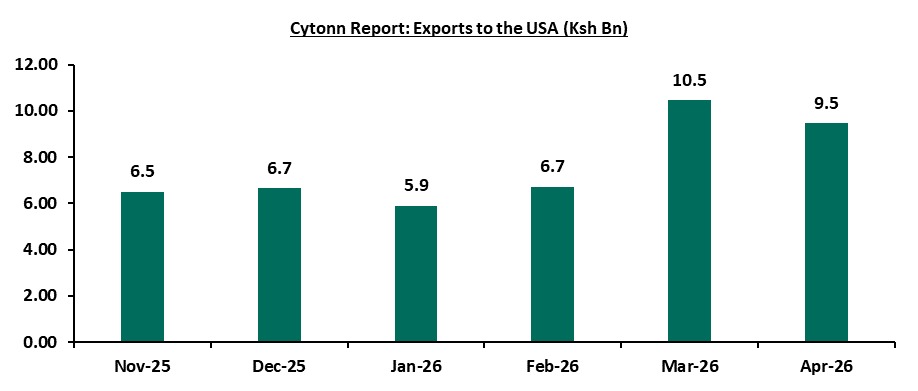
Kenya’s exports to the United States posted a strong recovery in the first four months of 2026, providing a welcome boost to the country’s export sector at a time when demand from key Gulf markets has weakened. Data shows exports to the US climbed from Kshs 5.9 billion in January to Kshs 6.7 billion in February, before surging to Kshs 10.5 billion in March and easing slightly to Kshs 9.5 billion in April.
The growth helped offset declining exports to the United Arab Emirates, where shipments fell by 27.5% to Kshs 2.9 billion in April from Kshs 4.0 billion in December 2025. The decline has largely been attributed to trade disruptions linked to the Iran conflict, which affected shipping routes and regional demand.
While the rebound in exports to the US appears encouraging, much of the increase has been driven by the reinstatement of the African Growth and Opportunity Act (AGOA) in February 2026. Kenyan exporters had spent several months facing tariffs of up to 42%, making their products less competitive in the American market. The return of duty-free access allowed exporters to recover lost ground rather than reflect a significant expansion in new demand.
However, the recovery comes with considerable uncertainty. AGOA’s current extension expires in December 2026, giving exporters only a one-year planning horizon compared to the longer extensions previously considered. This limited timeframe makes it difficult for manufacturers, particularly those operating in Kenya’s export processing zones, to make long-term investment decisions, expand production capacity or secure multi-year supply contracts with international buyers.


The outlook is further complicated by evolving US trade policy. Washington has increasingly indicated that future trade arrangements with African countries are likely to require greater reciprocity, with expanded access for American goods in exchange for preferential market access into the United States. Such a shift would mark a significant departure from the non-reciprocal framework that has supported Kenya’s exports under AGOA since 2000.
The latest export figures demonstrate Kenya’s resilience in adapting to shifting global trade dynamics. However, they also highlight the country’s continued dependence on preferential trade arrangements. As the December deadline approaches, securing a stable and predictable trade framework with the United States will be critical to sustaining export growth, protecting jobs and maintaining Kenya’s competitiveness in one of its most important international markets.