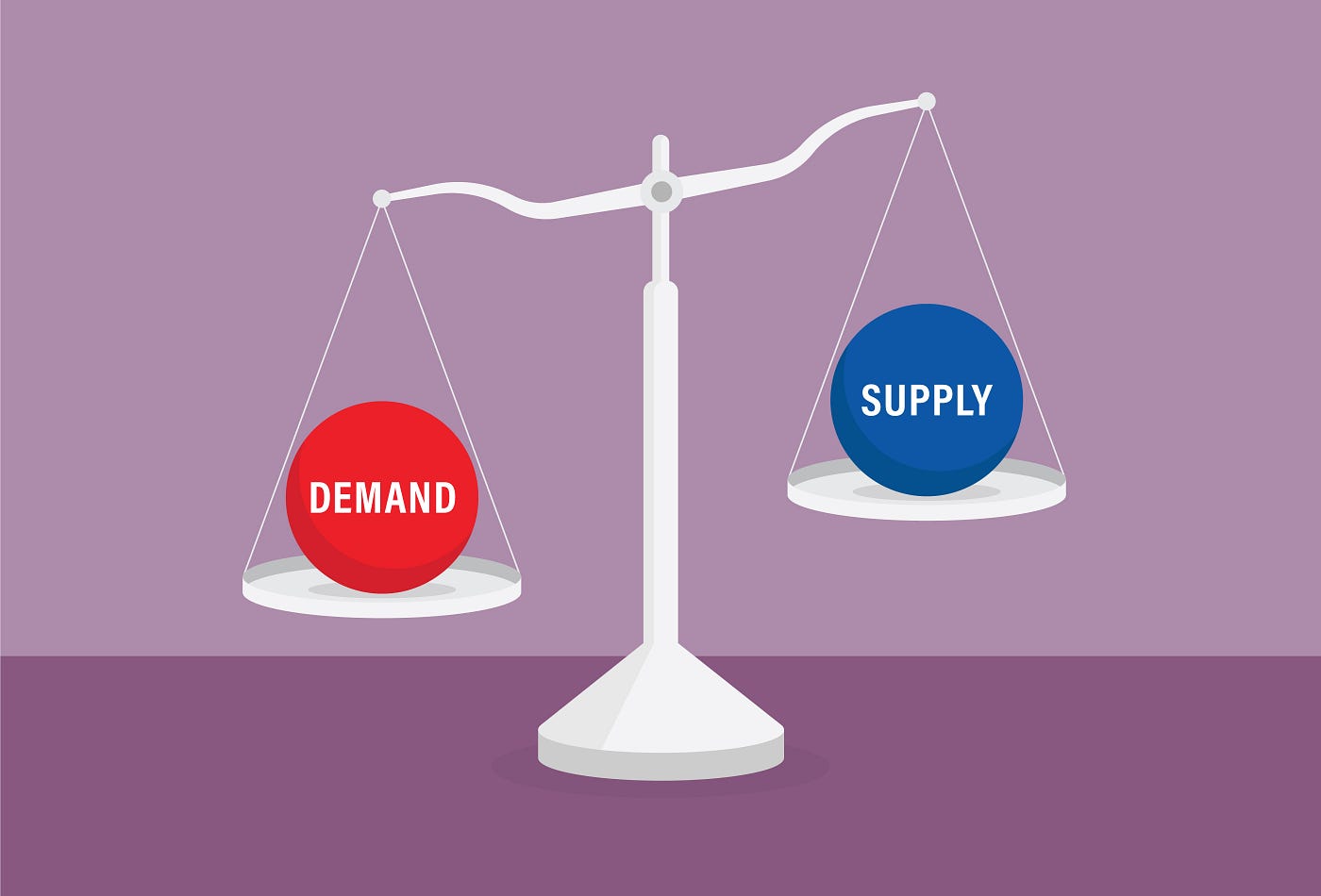
Supply and demand stand as fundamental concepts governing the determination of quantity and price for goods or services through the interplay of market buyers and sellers. The law of demand asserts that, ceteris paribus, the quantity demanded decreases as the price increases, and vice versa. Conversely, the law of supply posits that, ceteris paribus, the quantity supplied increases as the price rises, and vice versa. These principles typically result in a downward-sloping demand curve and an upward-sloping supply curve for most goods and services.
Notwithstanding, exceptions to these laws exist, notably Giffen goods and Veblen goods, which exhibit upward-sloping demand curves, challenging conventional economic and consumer behavior theories and introducing bias into supply and demand analyses.
A Giffen good, a low-income, non-luxury item constituting a significant portion of a consumer’s budget with no close substitutes, like salt, rice, or maize flour, defies the law of demand. When the price of a Giffen good rises, the resulting decrease in real income compels consumers to purchase more of the costly good to meet basic needs, creating a positive income effect that outweighs the negative substitution effect, thereby increasing demand.
Conversely, a Veblen good, a high-income, luxury product with a strong brand identity and status-symbolic value, such as designer jewelry or a luxury car, challenges the law of demand by experiencing increased demand as its price rises. This positive network effect, wherein heightened exclusivity and desirability drive increased demand, outweighs the negative income effect.

The presence of Giffen and Veblen goods introduces bias into supply and demand curve analyses, suggesting that factors like income, preferences, and expectations, rather than the intersection of supply and demand curves, determine market equilibrium. This complicates predictions of market outcomes and optimal pricing strategies for these goods.
The implications of Giffen and Veblen goods extend to their impact on resource allocation, income distribution, and population welfare in developing countries like Kenya. Despite Kenya’s progress in political and economic reforms, social development, and sustained growth, challenges persist, including poverty, resource inequality, youth unemployment, climate change, and vulnerability to shocks.
In Kenya, Giffen goods, such as staple foods like maize flour, can exacerbate food insecurity and malnutrition among the poor, diverting a significant portion of their income away from more nutritious options. Meanwhile, the consumption of Veblen goods by the wealthy may contribute to increased income inequality and social polarization, diverting funds from productive activities.
The bias introduced by Giffen and Veblen goods can negatively impact Kenya’s economic growth by distorting market signals, reducing economic efficiency and equity, and hindering societal human development. Addressing these issues requires the implementation of policies by the Kenyan government to improve access and affordability of basic goods and services, promote economic diversification and innovation, and foster social cohesion and inclusion.