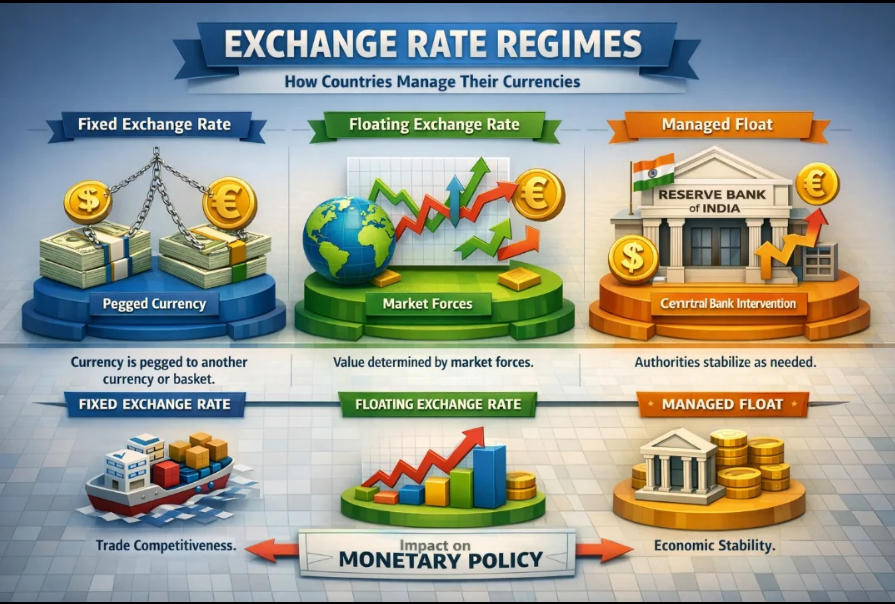
Exchange rate regimes play a fundamental role in shaping a country’s macroeconomic environment, influencing inflation, trade competitiveness, capital flows, and overall economic stability. An exchange rate regime refers to the system a country adopts to determine how its currency is valued relative to others. The choice of regime—whether fixed, floating, or a hybrid approach—has important implications for how an economy responds to both domestic and external economic conditions.
A fixed exchange rate regime involves pegging a country’s currency to another major currency or a basket of currencies. This approach provides stability in international trade and investment by reducing exchange rate volatility. Businesses and investors benefit from predictable currency values, which makes planning and cross-border transactions easier. However, maintaining a fixed exchange rate requires significant foreign exchange reserves and may limit a country’s ability to conduct independent monetary policy, particularly during economic shocks.
In contrast, a floating exchange rate regime allows currency values to be determined by market forces such as supply and demand. Under this system, exchange rates adjust automatically in response to changes in economic fundamentals, including inflation, interest rates, and trade balances. A floating regime provides greater flexibility for monetary policy, enabling central banks to respond to domestic economic conditions more effectively. However, it may also lead to higher exchange rate volatility, which can introduce uncertainty for investors and businesses engaged in international trade.
Some countries adopt a managed or hybrid exchange rate regime, combining elements of both fixed and floating systems. In such arrangements, the central bank may allow the currency to fluctuate within a certain range while intervening in the foreign exchange market when necessary to prevent excessive volatility. This approach seeks to balance stability with flexibility, providing a degree of control while still allowing market forces to play a role.


Exchange rate regimes have a direct impact on inflation dynamics. In a fixed regime, imported inflation can be controlled if the pegged currency remains stable. However, if the domestic economy experiences inflationary pressures that differ from those of the anchor currency, maintaining the peg can become challenging. In a floating regime, currency depreciation may increase the cost of imports, contributing to higher inflation, while appreciation can help reduce inflationary pressures.
Trade competitiveness is another area influenced by exchange rate systems. A weaker currency can make exports more competitive in global markets by lowering their relative prices, while a stronger currency can make imports cheaper but reduce export competitiveness. The choice of exchange rate regime therefore affects how an economy positions itself in international trade.
Capital flows and investor confidence are also shaped by exchange rate arrangements. Stable and predictable exchange rate systems may attract foreign investment by reducing currency risk. However, overly rigid systems can create vulnerabilities if market conditions change significantly. Flexible regimes may better absorb external shocks but can expose investors to exchange rate fluctuations.
Ultimately, the effectiveness of an exchange rate regime depends on how well it aligns with a country’s economic structure, policy objectives, and external environment. Policymakers must carefully balance the trade-offs between stability and flexibility to support sustainable economic growth and resilience.