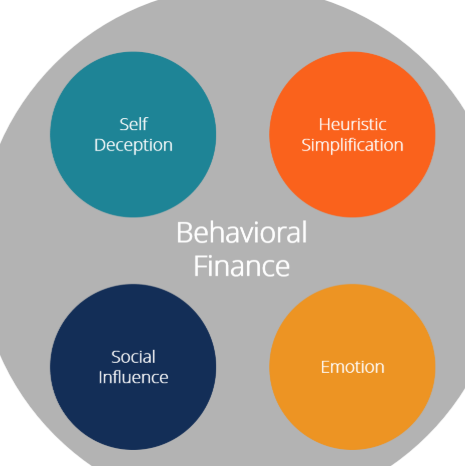
Financial markets are often described as mechanisms where investors process information and make rational decisions. However, actual investor behavior can differ significantly from this assumption. Emotions, personal experiences, social influences and psychological biases can all affect how investors interpret information and make financial decisions.
This area of investment analysis has led to the development of behavioral finance, which examines how psychological factors influence investor decisions and financial market outcomes. Understanding these factors has become increasingly important because individual decisions can influence broader market movements when many investors respond to information in similar ways.
One of the most recognizable behavioral patterns is herding. Herding occurs when investors follow the actions of other market participants instead of relying primarily on their own analysis. The behavior often becomes stronger when investors face uncertainty and assume that other market participants may have better information or judgment.
For example, a stock that records rapid price gains may attract investors who previously had little interest in it. They may purchase the stock because other investors are buying it or because they fear missing a potential opportunity. Increased demand can push the price higher, which may attract even more investors. The resulting cycle can continue even when the company’s underlying financial performance has changed very little.


The opposite can occur when investors become fearful. A decline in asset prices can trigger additional selling as investors attempt to avoid further losses. If enough investors respond in the same way, selling pressure can accelerate the decline.
Loss aversion represents another important influence on investment decisions. Investors often respond more strongly to financial losses than to equivalent gains. This can affect portfolio decisions when an investment begins to decline. Rather than reassessing the investment objectively, an investor may continue holding it because selling would make the loss visible and permanent.
Overconfidence can create a different set of challenges. Investors may overestimate their ability to forecast market movements or identify securities that will outperform. This confidence can encourage excessive trading, increase transaction costs or result in portfolios that depend too heavily on a small number of investments.
Other behavioral biases can also influence financial decisions. Confirmation bias can cause investors to give greater attention to information that supports an existing view while overlooking evidence that challenges it. Recency bias, meanwhile, can lead investors to place too much weight on recent events when assessing future performance.
These biases do not necessarily operate independently. An investor could, for example, become overconfident after several successful trades and then rely heavily on recent market performance when making the next investment decision. Such interactions can increase the risk of poor decision-making.
Behavioral biases become particularly significant when large numbers of investors respond to information in similar ways. Collective behavior can contribute to periods of excessive optimism, rapid price increases and sharp market sell-offs.
Traditional financial models may not fully explain some of these market characteristics because they often assume that investors process information rationally and consistently. Behavioral finance provides another perspective by considering how emotions and cognitive biases can influence the way investors interpret the same information.
This is particularly relevant in markets where uncertainty can quickly affect investor confidence. In Kenya, political developments, company announcements, economic data and market rumors can influence trading activity. Investors may react to these developments before they have fully assessed their potential impact on company earnings, valuations or broader economic fundamentals.
Such reactions can increase market volatility. However, behavioral finance does not suggest that every market movement results from irrational behavior. Instead, it highlights the importance of considering both financial information and the way investors respond to that information. Investors cannot completely remove emotions from financial decision-making. They can, however, introduce processes that reduce the influence of psychological biases.
Setting clear investment objectives can provide a framework for decision-making. Diversification can reduce the consequences of excessive concentration in individual securities. Fundamental analysis can help investors evaluate an investment based on financial performance, valuation and long-term prospects rather than short-term market sentiment.
Investors can also establish clear entry and exit criteria before making an investment. Having predetermined guidelines can reduce the likelihood of making impulsive decisions when markets become highly volatile.
For investment analysts, understanding investor psychology adds another dimension to financial analysis. Financial statements, economic indicators and valuation metrics remain important, but they do not always explain how investors will respond to new information.
Financial markets respond not only to information but also to how investors interpret and act on that information. Herding, loss aversion, overconfidence, confirmation bias and recency bias can influence individual decisions and, when they occur across large groups of investors, contribute to broader market movements.
Behavioral finance therefore provides an important complement to traditional financial analysis. For investors and analysts, recognizing psychological influences can support more disciplined decision-making and provide greater insight into periods of strong optimism, market uncertainty and rapid sell-offs.