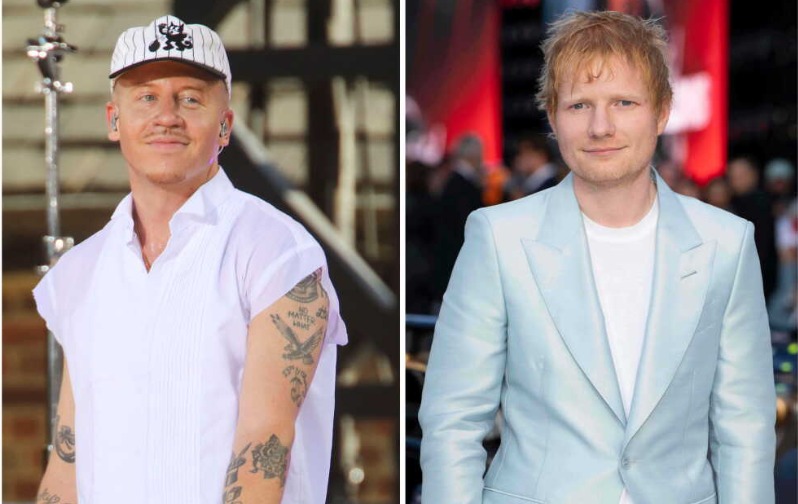
What was supposed to be a series of concerts built around music and entertainment has turned into a debate over political expression, artistic freedom and the boundaries of live performance. Ed Sheeran’s Loop Tour was thrown into turmoil after rapper Macklemore was removed from the remaining US dates following pro-Palestinian comments made during his performances, prompting the other supporting acts to withdraw in solidarity.
The controversy began after Macklemore spoke about Gaza during performances at New Jersey’s MetLife Stadium on September 4 and 5. During one appearance, he expressed support for Palestinians and used the phrase “Free Palestine”. His comments subsequently triggered opposition from some US venue owners, including Robert Kraft, the owner of Gillette Stadium and the New England Patriots. The Israeli American Council also launched a petition calling for Macklemore’s removal from the tour.
Messina Touring Group, the promoter of Sheeran’s US tour, ultimately confirmed that Macklemore would no longer perform on the remaining dates. Sheeran subsequently sought to distance himself from the decision, saying the removal was made by the promoter after venues indicated they would not host shows featuring Macklemore. He said he had attempted to find a solution involving the different parties but that the promoter and venues had made the final decision.
The decision, however, had consequences well beyond the removal of one opening act. Aaron Rowe, Lukas Graham, Finneas and Irish band Beoga all withdrew from the tour, with their departures explicitly framed as solidarity with Macklemore. Finneas, who was scheduled to perform on six South American dates, said artists should not be silenced for speaking about oppression. Beoga had also been performing alongside Sheeran during his sets.


The result was an unusual situation for one of the world’s biggest touring artists: Sheeran was suddenly left without the supporting lineup that had been planned for several upcoming performances. The dispute also transformed the tour from a commercial entertainment event into a highly visible argument about where the boundaries between artists, promoters and venue owners should lie.
Sheeran’s own position has been more complicated. In his public statement, he said he was “appalled” by the conflict between Israel and Palestine and described the suffering on both sides as a human tragedy. He also maintained that he wanted his concerts to remain spaces centred on music, unity and humanity rather than political division.
That position came under renewed scrutiny when Sheeran performed in Philadelphia on September 19. With the opening acts gone, he began the concert alone on stage and apologised to fans, acknowledging that he had made mistakes while dealing with the controversy. He also addressed the situation in Gaza, describing it as catastrophic and unjustifiable while reiterating that he wanted his concerts to bring people together.
The Philadelphia performance illustrated the commercial and reputational complications created by the dispute. Fans had bought tickets expecting a particular lineup, while the artist was forced to address an issue that extended far beyond the original purpose of the concert. Demonstrators also gathered outside the venue, showing that the controversy had moved beyond social media and into the physical spaces hosting the tour.
At the centre of the dispute is a broader question facing the music industry: Can an artist’s political expression remain separate from the commercial interests of a tour? Macklemore’s supporters have framed his removal as an issue of artistic freedom, while Kraft has defended the decision by pointing to what he described as Macklemore’s comments and broader history that he believes have been offensive to the Jewish community. These competing positions have made the controversy about more than one artist’s remarks.
For Sheeran, the immediate challenge is continuing the tour while navigating expectations from fans, venues, fellow musicians and audiences with sharply different views on the conflict. For the wider music industry, the episode highlights how quickly political speech by an artist can affect promoters, venue operators, touring partners and ultimately the audience.
The controversy has therefore left Sheeran’s Loop Tour facing a very different spotlight from the one under which it began. What started as a concert lineup dispute has evolved into a wider debate over political expression, freedom of speech, commercial pressure and whether musicians can realistically keep politics outside the stage.