Kenya’s public debt profile has been a focal concern for policymakers and investors. Recent credit rating actions by principal global agencies provide valuable insight into risk perceptions, but also reveal the complexities behind headline ratings.
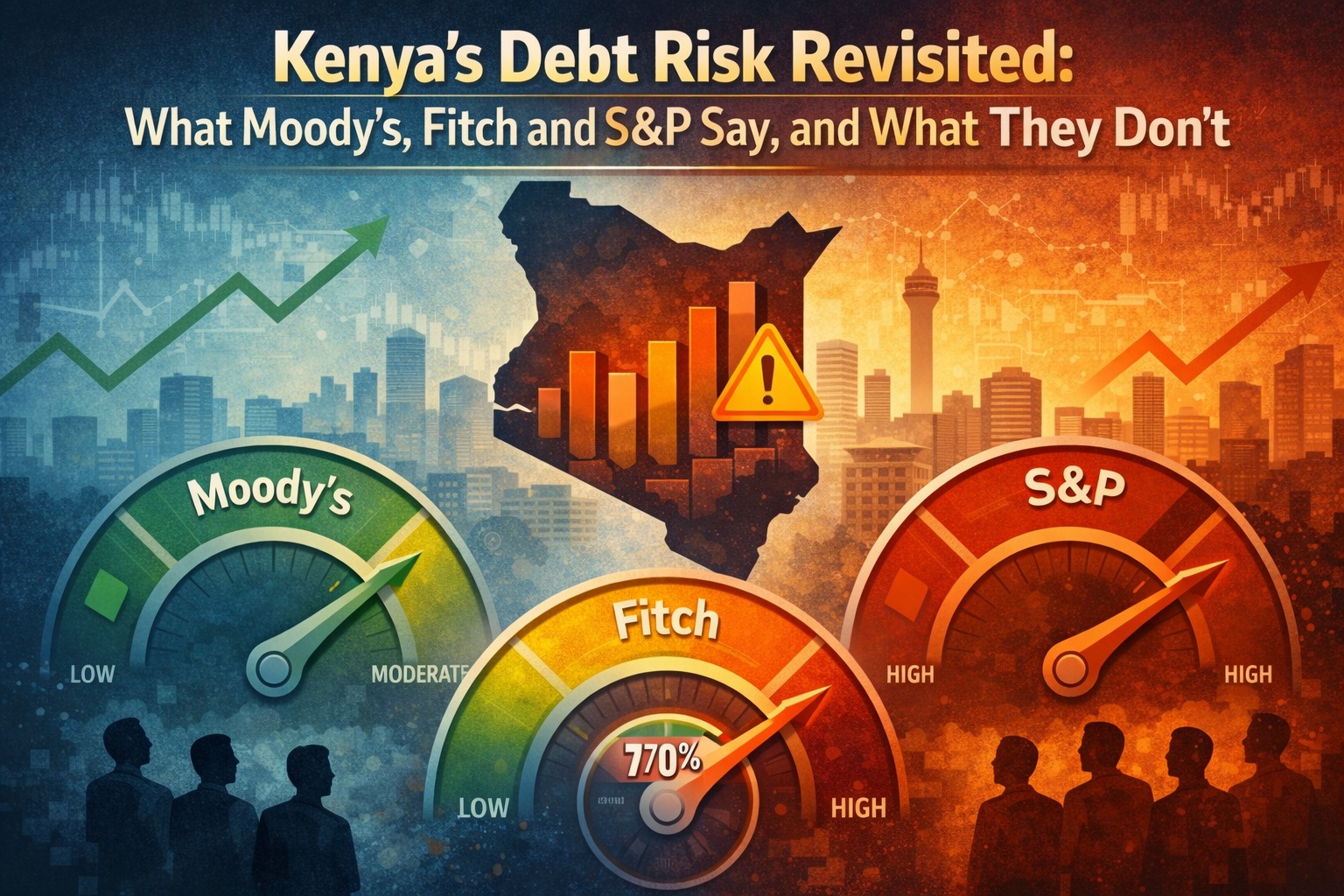
In January 2026, Moody’s upgraded Kenya’s sovereign credit rating to B3 from Caa1 and revised the outlook to stable, signaling a reduction in near-term default risk underpinned by stronger external liquidity, higher foreign exchange reserves, and smoother access to domestic and international financing. The agency noted that improved debt management operations, including returning to international bond markets and liability management, helped ease refinancing pressures.


Earlier, in August 2025 S&P Global Ratings upgraded Kenya’s long-term sovereign credit rating to ‘B’ with a stable outlook, citing a reduction in external liquidity risks thanks to robust export performance and strong diaspora remittances that bolstered foreign exchange reserves. Despite lingering fiscal challenges, S&P maintained a stable outlook on the back of expected economic growth and improved balance of payments dynamics.
Fitch Ratings has similarly affirmed Kenya’s sovereign credit rating at ‘B-’ with a stable outlook, acknowledging moderated external liquidity pressures, proactive liability management and strengthening reserves. However, Fitch emphasized that public debt remains elevated, at about 67.8 % of GDP by mid-2025, and that structural fiscal risks persist, including high interest costs relative to revenue, which constrain long-term debt sustainability.
These ratings reflect a trajectory of stabilization rather than resolution. Kenya has made measurable progress in easing immediate liquidity stresses and shoring up foreign exchange buffers, which reduces default risk as reflected in the recent upgrades and affirmations. Yet it remains outside investment-grade territory, and public debt ratios are projected to stay above benchmark thresholds for several years.
What mainstream ratings often capture effectively is near-term liquidity and external financing risks. Short-term pressures ease when reserves improve and markets react positively to liability management. However, ratings may understate structural debt vulnerabilities linked to long maturities, high debt servicing costs, and the relative weakness of revenue mobilization versus expenditure rigidity. These factors shape medium-term sustainability even if they do not trigger immediate rating downgrades.
As a result, while public debt metrics show signs of moderation, the story is not one of complete recovery. Ratings provide a snapshot of sovereign risk assessments, but they do not fully reflect underlying fiscal dynamics over the medium term. A stable outlook indicates managed risks, not the elimination of all concerns.
The real test going forward will be consistent fiscal discipline, sustained revenue growth, and deeper structural reforms that reduce dependency on expensive debt and enhance resilience to external shocks. Only with these fundamentals can Kenya move from stabilizing its debt profile to genuinely reducing debt distress risk, beyond what ratings alone imply.
Start your investment journey today with the Cytonn Money Market Fund. Call + 254 (0)709101200 or email sales@cytonn.com