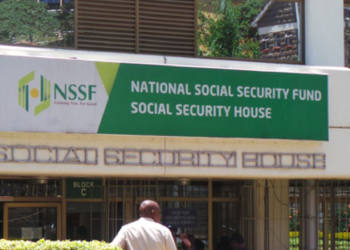
The National Social Security Fund (NSSF) Act of 2013 was a landmark reform in Kenya’s social protection framework. Before its enactment, the NSSF largely operated as a provident fund, paying lump sums at retirement an approach that often left members exposed to financial insecurity in later years. The Act converted NSSF into a pension scheme designed to deliver regular monthly benefits, aligning Kenya with international best practices and strengthening long-term income security for retirees.
Implementation was deliberately phased to balance affordability and sustainability for employers and employees. The first phase, beginning in February 2023, introduced a two-tier contribution structure. Tier I covers lower-income earnings, while Tier II applies to earnings above Tier I up to the statutory ceiling. During this phase, Tier I was capped at KES 6,000.0 and Tier II at KES 18,000.0. Contributions are shared between employer and employee, marking the shift from a simple, flat-rate provident model to an equitable, earnings-linked pension framework that reflects capacity to contribute.
The second and third phases, effective 2024 and February 2025 respectively, enhanced contribution rates and expanded coverage, with a deliberate emphasis on drawing in Kenya’s vast informal sector. The lower limit was raised to KES 8,000.0 from KES 7,000.0 while the upper limit was raised to KES 72,000.0 from KES 36,000.0. This broadened participation strengthens social protection by widening the contributory base, while higher, phased-in remittances deepen retirement savings without creating sudden cost shocks for employers. The rationale is clear: sustained, incremental growth in contributions builds reserves that can be prudently invested for long-term returns, fortifying the scheme’s solvency and benefits adequacy.
The fourth phase, scheduled for February 2026, will complete the transition to a fully-fledged pension system. From February 2026, the caps will increase again to KSh 9,000 for Tier I and KSh 108,000 for Tier II, representing the fourth year of applying the enhanced contribution limits provided for in the legislation. Under the revised thresholds, Tier I will require a monthly deduction of 6.0%, amounting to KES 540.0 per employee from KES 480.0 currently, which will be matched by the employer. Tier II contributions will then be computed on income exceeding the Tier I ceiling, up to the new maximum limit. For an employee earning KES 100,000, Tier I will contribute KES 540.0, while Tier II will apply to the remaining KES 91,000.0, yielding a contribution of KES 5,460.0. This raises the employee’s total monthly deduction to KES 6,000.0, compared to the current KES 4,320.0. With a matching employer contribution, the employee’s total monthly retirement savings will increase to KES 12,000.0, from the current KES 8,640.0.


The Act’s rationale rests on modernization, inclusivity, and sustainability. By phasing reforms and structuring contributions across tiers, it cushions stakeholders from abrupt financial burdens while building a robust pool of retirement capital. Its importance is multi-layered: it reduces old-age poverty by guaranteeing income continuity; provides employers with a clear, predictable compliance framework; and channels long-term domestic savings into productive investments that support national development. In essence, the NSSF Act of 2013 safeguards the dignity of Kenyan workers after years of service, strengthens social protection across the formal and informal economies, and anchors a more resilient financial future for households and the country alike.