Sharp Daily
No Result
View All Result
Tuesday, May 19, 2026
  • Home
  • News
    • Politics
  • Business
    • Banking
  • Investments
  • Technology
  • Startups
  • Real Estate
  • Features
  • Appointments
  • About Us
    • Meet The Team
Sharp Daily
  • Home
  • News
    • Politics
  • Business
    • Banking
  • Investments
  • Technology
  • Startups
  • Real Estate
  • Features
  • Appointments
  • About Us
    • Meet The Team
No Result
View All Result
Sharp Daily
No Result
View All Result
Home Technology

Kenya unveils plan for 1,000 EV charging stations by 2027

Brian Murimi by Brian Murimi
September 15, 2023
in Technology
Reading Time: 2 mins read

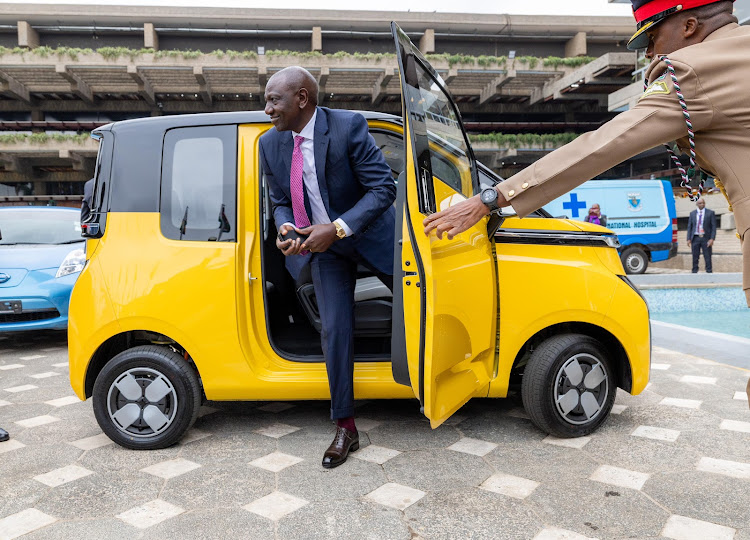
The administration of President William Ruto aims to construct 1,000 electric vehicle charging stations across Kenya under its ambitious economic development plan from 2022 to 2027.

The plan envisions 700 stations in urban areas and 300 along highways.

The massive infrastructure project was outlined Thursday in new “Electric Vehicle (EV) Charging and Battery Swapping Infrastructure Guidelines” from the Energy and Petroleum Regulatory Authority. The comprehensive guidelines aim to promote accessibility, reliability and affordability of charging systems in order to accelerate EV adoption nationwide.

Read more: Money Market Funds balloon into financial force as Kenyans swarm with investments

RELATEDPOSTS

Budget cuts weaken Kenya’s fight against money laundering

January 19, 2026
Supporters of Uganda’s incumbent president and National Resistance Movement (NRM) presidential candidate Yoweri Museveni celebrate during a party gathering for the announcement of final results for the 2026 Ugandan presidential election at Lugogo Grounds in Kampala on January 17, 2026. Uganda's President Yoweri Museveni, 81, won a seventh term in office on on January 17, 2026 with 71.65 percent of the vote, the country's Electoral Commission said. (Photo by Luis TATO / AFP)

Museveni wins seventh Term: what It means for Uganda’s future

January 19, 2026

“The purpose of these guidelines is to enable faster adoption of electric vehicles in Kenya by ensuring safe, reliable, accessible and affordable charging infrastructure and ecosystem,” the authority’s statement said.

Under the guidelines, public charging stations must meet extensive minimum requirements including having dedicated transformers, civil works like ramps, restroom facilities, fire safety equipment, and using only certified and approved charging equipment. Private charging points at homes or businesses have fewer infrastructure requirements but still need inspection and approval.

Battery swapping stations, where EV batteries can be quickly exchanged for fully charged ones, must meet detailed standards for space, battery management systems, unique identification numbers on each battery, and overall safety.

The guidelines also stipulate that installers must provide documentation, warranties and insurance. There are specifications for minimum distance between public charging points, and a national database of all stations will be created.

Read more: Roam’s New Electric Bike Assembly Plant in Kenya Marks a Green Revolution in the Mobility Sector

Signage, accessibility for disabled persons, and fair pricing requirements are outlined. Technical requirements cover measurement systems, smart functionality, communication systems, data privacy and cybersecurity.

Complaints about stations or installers will be handled by the Energy Regulatory Authority. The comprehensive guidelines take effect September 1.

According to the government, imports of electric vehicles began about 10 years ago, driven mainly by the private sector. But uptake has been slow due to high costs compared to gasoline models, insufficient charging infrastructure nationwide, and uncertainties about sustainable energy supply.

“With government support, electric vehicles have started to penetrate the Kenyan market. However, there is currently no framework that encourages uptake and penetration through an enabling framework,” the statement said. “These new guidelines aim to change that.”

Email your news TIPS to editor@thesharpdaily.com

Previous Post

Money Market Funds balloon into financial force as Kenyans swarm with investments

Next Post

Matatu fares rise as owners cite fuel cost hike

Brian Murimi

Brian Murimi

Brian Murimi is a communications and advocacy professional with a focus on innovation, policy and continental development in Africa. A former journalist, he now works at the intersection of knowledge, strategy, and pan-African institution building.

Related Posts

Analysis

Co-op bank Q1 profit rises on digital growth

May 15, 2026
Analysis

Safaricom hits ksh 100bn profit mark

May 14, 2026
Analysis

Fuliza disbursements hit kSh 1.47 tTrillion

May 8, 2026
Analysis

Taifa gas eyes kenyan market with major LPG investment

May 6, 2026
Technology

Amazon seeks License to offer satellite internet in Kenya

April 29, 2026
Business

M-Pesa drives surge in NSE retail trading

April 20, 2026

LATEST STORIES

The Spotify “Disco Ball” Branding Stunt

May 18, 2026

Court to decide on Kenya’s Sh204 billion Safaricom stake sale

May 18, 2026

The influence of commodity prices on investment markets

May 18, 2026

Safaricom’s fuel strategy highlights growing energy risks facing Africa’s digital economy

May 15, 2026

Member Engagement and Financial Literacy in Retirement Planning

May 15, 2026

Why fuel prices in Africa stay high when oil prices fall — and who Mercy Corps is holding responsible

May 15, 2026

Hantavirus on a luxury cruise ship: what we know, what we don’t, and why the WHO says stay calm

May 15, 2026

How Government Borrowing Influences Market Interest Rate

May 15, 2026
  • About Us
  • Meet The Team
  • Careers
  • Privacy Policy
  • Terms and Conditions
Email us: editor@thesharpdaily.com

Sharp Daily © 2024

No Result
View All Result
  • Home
  • News
    • Politics
  • Business
    • Banking
  • Investments
  • Technology
  • Startups
  • Real Estate
  • Features
  • Appointments
  • About Us
    • Meet The Team

Sharp Daily © 2024