
Kenya’s special funds have quietly become the darlings of retail investing, and it is not hard to see why. According to reporting by Kepha Muiruri in the Business Daily, these unconstrained collective investment vehicles now hold Sh203.5 billion, a record 23.9 per cent share of all collective investment schemes as of the end of March 2026. That is money that, as the article notes, could comfortably fund an entire government ministry for a year. But growth this fast rarely happens without someone asking hard questions, and the Capital Markets Authority has now done exactly that.
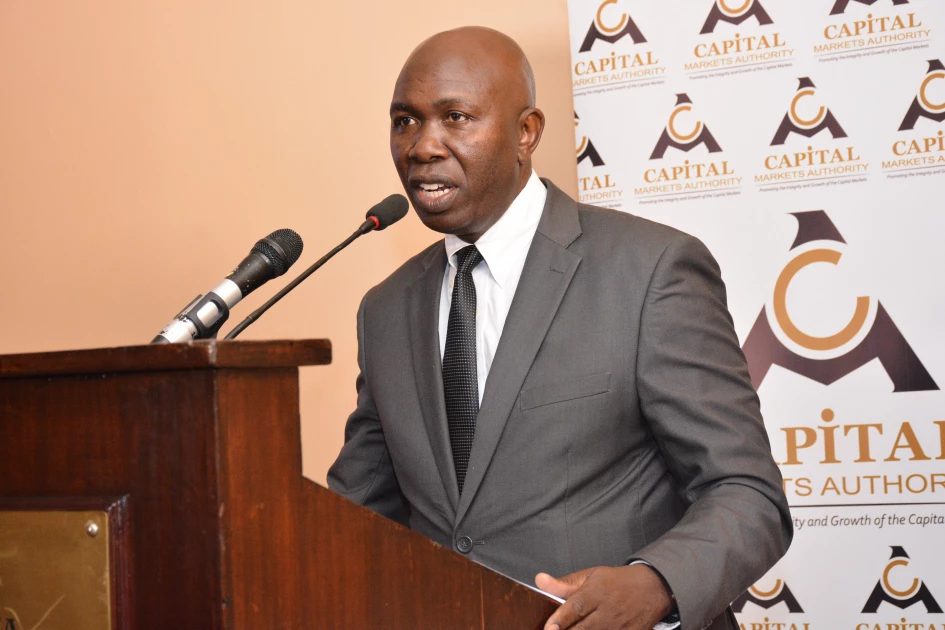
The regulator’s closed-door meeting with special fund managers on July 2, described by industry sources as a ‘housekeeping exercise,’ was really about something more pointed: unethical marketing, thin disclosure, and the growing use of unqualified sales agents, including social media influencers, to sell complex financial products to everyday Kenyans. Fund Managers Association CEO Fred Mburu did not shy away from naming the core tension when he asked, in effect, whether clients actually understand the risk behind the returns they are being sold.
The Numbers Behind the Hype
It is worth sitting with why special funds have pulled ahead so decisively. In the quarter ended March 2026, they grew four times faster than money market funds, expanding 25 per cent to Sh203.5 billion while MMFs inched up just 4 per cent. Funds like Standard Investment Bank’s Mansa-X, which dominates the category with 76.8 percent of assets under management, posted annualized half-year returns above 23 percent. Faida Investment Bank’s Oak Special Fund was not far behind at over 20 per cent. Against a backdrop of falling interest rates squeezing traditional Treasury bill and fixed-deposit returns, it is easy to understand why Kenyan investors, whom the article describes as ‘returns-obsessed’, have gravitated toward these vehicles.
The trouble is that unconstrained mandates, by design, allow fund managers to chase higher-risk instruments across equities, private equity, offshore stocks, and commodities. That flexibility is precisely what generates market-beating returns, and precisely what can generate outsized losses. Management fees of up to 6 per cent, plus performance charges, only sharpen the need for investors to know exactly what they are paying for.
Disclosure Is the Real Issue, Not Just Returns
What stands out in this story is that the CMA’s concern is not that special funds exist or even that they carry risk. Every investment does. The concern is whether investors are being given enough information to price that risk for themselves. Annualising quarterly returns rather than reporting straightforward quarterly yields, as the article points out, can flatter short-term performance in ways that mislead investors who do not read the fine print. Add to that an anonymous fund manager’s worry, cited in the report, that some funds may be using fresh client inflows to paper over quarterly losses, and the picture becomes one of an industry that has outgrown its current guardrails.
This is compounded by fraud risk. The article references the May arrest of a man accused of defrauding investors of Sh33.6 million through a cloned investment platform, a reminder that the same appetite for high returns that fuels legitimate special funds also creates fertile ground for scammers exploiting the same narrative.
Adding to investor confusion, a fabricated circular impersonating the CMA went viral shortly after the genuine July 2 meeting became public. The fake notice claimed the Authority had identified specific licensed collective investment schemes offering ‘abnormally high returns’ and was directing affected investors to withdraw their funds immediately, warning that non-compliant schemes would have their licences revoked. On July 7, 2026, the CMA issued a public clarification distancing itself from the document, confirming it was fabricated and had not been issued by the authority. The regulator reiterated that all genuine announcements are published exclusively through its official website and verified social media channels and urged the public not to act on unverified circulars.
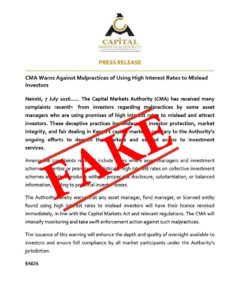
The episode is a useful case study in itself: even as the CMA works to tighten disclosure standards around real special funds, bad actors are exploiting the same headlines to spread panic and misinformation. Investors should treat any urgent, unverified ‘withdraw now’ notice with the same skepticism the CMA is asking fund managers to apply to their own marketing claims and confirm any regulatory communication directly on cma.or.ke before acting on it.
What This Means for Kenyan Investors
For everyday investors, the sensible takeaway is not to avoid special funds but to interrogate them the same way a fund manager would interrogate any risky asset. Ask how returns are calculated and reported. Ask what happens in a bad quarter, since the CMA itself warns that these funds are structured to smooth losses over the long term, meaning short-term investors could face sharp drawdowns if they exit at the wrong time. And be wary of anyone selling a special fund, or a scare-driven withdrawal notice, on social media without the qualifications or verification to back it up.
This commentary is based on original reporting by Kepha Muiruri, published in the Business Daily, “CMA warns special funds on ‘abnormal’ returns promises,” and on CMA’s July 7, 2026, public clarification refuting a fabricated circular, as reported by Kenyans.co.ke, “CMA Refutes Claims of Plans to Revoke Licenses of Several Investment Schemes.”