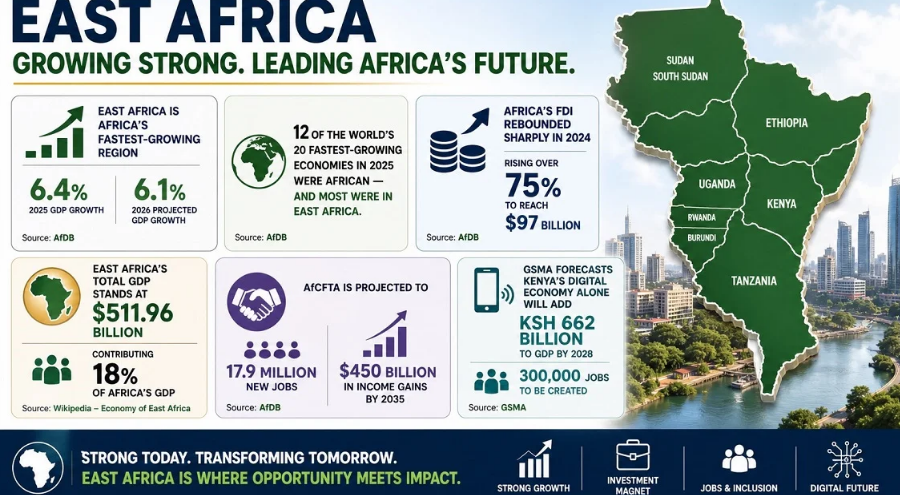
Kenya is intensifying efforts to deepen East African integration as businesses increasingly look beyond the domestic market for growth. For investors, the development could create a larger addressable market for Kenyan companies while encouraging businesses to build regional production, distribution and supply networks. The East African Community (EAC) has expanded significantly in recent years, with the Democratic Republic of Congo (DRC) and Somalia joining the bloc. Kenya’s Ministry of Foreign Affairs considers regional integration an important component of the country’s economic transformation agenda, with the potential to expand markets, attract investment and strengthen regional value chains.
The scale of the opportunity is already reflected in Kenya’s position within the regional economy. Kenya contributes 43.1% of the EAC’s economic output, making it the bloc’s largest economic contributor, followed by Tanzania at 30.0% and Uganda at 17.9%. Rwanda, Burundi and South Sudan account for smaller portions of the regional economy. These figures underline Kenya’s existing economic weight, but deeper integration could allow businesses to capture value beyond the domestic market.
The opportunity extends beyond exporting finished goods. A more integrated regional economy could encourage companies to establish production facilities and distribution networks across multiple countries. Kenyan manufacturers, for example, could source inputs from neighboring markets, locate production closer to consumers and use Kenya’s established transport, financial and commercial infrastructure as a regional base. Larger markets could also allow businesses to spread fixed costs across higher production volumes and improve economies of scale.


Several sectors could benefit from this expansion. Logistics and transport companies could experience higher demand as regional trade increases, while manufacturers could gain access to a broader customer base. Banks and financial-technology companies could benefit from rising demand for cross-border payments, trade finance and other financial services. Telecommunications providers, retailers and consumer-facing companies could similarly expand their markets as businesses and consumers become more connected across borders.
Infrastructure will remain central to achieving these benefits. Kenya is positioning the Northern Corridor, which connects the Port of Mombasa with markets across the region, as a key trade and logistics route. The government’s Northern Corridor Development Strategy seeks to address high logistics costs, operational inefficiencies and connectivity constraints. Improvements in these areas could reduce the time and cost required to move goods across borders and make regional production networks more commercially viable.
However, non-tariff barriers remain a significant constraint. In July 2026, the EAC called for faster action to address border bottlenecks, regulatory obstacles and administrative requirements that raise the cost of regional trade. Removing these barriers will be important if businesses are to fully benefit from the bloc’s expanding geographic and economic footprint.
Trade integration also has a quantitative target. The EAC aims to increase intra-regional trade to 50.0% by 2030. Achieving this objective would require continued progress in customs procedures, transport infrastructure, regulatory harmonization and cross-border business operations.
Financial integration could provide another catalyst. In June 2026, the African Development Fund approved a USD 9.0 million grant for a regional initiative aimed at strengthening capital markets and payment systems across East Africa and the Horn of Africa. The project seeks to facilitate cross-border investment and improve access to long-term financing, potentially strengthening the financial infrastructure required to support regional economic expansion.
For investors, East African integration therefore represents more than a political or institutional process. It could become a market-expansion and investment theme with implications across manufacturing, logistics, financial services, telecommunications, retail and infrastructure. Companies that can scale across borders, manage regional supply chains and navigate different regulatory environments may have a stronger opportunity to capture the benefits of a more integrated market.
The pace of progress will ultimately determine the size of the opportunity. If governments reduce trade barriers, improve regional infrastructure and strengthen financial connectivity, East Africa could provide Kenyan businesses with a substantially broader platform for growth while creating new channels for domestic and international investment.