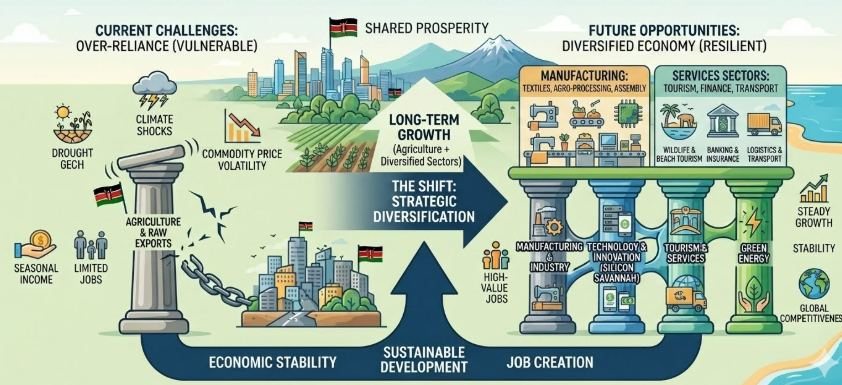
Kenya’s economy has maintained relatively strong growth despite global economic uncertainty, but sustaining this momentum will require a broader and more resilient economic base. Agriculture, tourism, trade, financial services, and other established sectors continue to support employment, exports, and national income. However, dependence on climate-sensitive activities and exposure to external economic conditions can leave the economy vulnerable to disruptions. Economic diversification can therefore strengthen resilience while creating new opportunities for investment, productivity, and employment.
Agriculture remains a major pillar of Kenya’s economy, contributing 19.0% of Gross Domestic Product (GDP) in Q1 2026. Overall GDP expanded by 4.9% in Q1 2026, down from 5.3% in Q1 2025, while agriculture accounts for approximately 72.0% of national employment. This concentration makes economic performance particularly sensitive to droughts, floods, and changing weather patterns. Climate-related disruptions can affect agricultural output, food prices, household incomes, and export earnings. Diversifying into manufacturing, agro-processing, logistics, technology, and other productive activities can reduce the economy’s reliance on weather-dependent production.
Manufacturing provides one of the strongest opportunities for diversification. The sector contributed 7.7% to GDP in Q1 2026 and accounts for more than 11.0% of formal employment. Kenya also ranks first in manufacturing competitiveness within the East African Community (EAC), supporting its position as a potential regional manufacturing hub. Emerging opportunities in e-mobility, textiles and apparel, and pharmaceutical manufacturing could help expand domestic production. Greater manufacturing capacity would allow the country to move further up regional and global value chains by converting more raw materials into higher-value products. This could increase export earnings, support SMEs, and generate employment beyond agriculture.
The financial and insurance services sector contributes 9.2% of GDP, highlighting the importance of services in Kenya’s economic structure. The country has also developed a strong position in financial technology, mobile payments, banking, and digital services. Further expansion into information and communication technology (ICT), business process outsourcing, e-commerce, professional services, and creative industries could create additional sources of growth. Digital businesses can also access international markets without the same level of physical infrastructure required by traditional industries, creating opportunities for firms to earn foreign exchange and expand employment.


Energy and green industries represent another avenue for broadening Kenya’s productive base. The country has significant renewable energy potential, particularly in geothermal, wind, and solar power. Expanding these resources can support investment in clean manufacturing, electric mobility, green construction, and climate-related services. Beyond reducing dependence on conventional energy sources, investment in renewable energy can strengthen energy security and connect Kenya to emerging global green value chains.
Economic diversification also has a direct relationship with employment resilience. Kenya’s young and expanding labor force requires the economy to generate productive opportunities across multiple sectors rather than relying heavily on a limited number of industries. A more diversified economy can provide alternative income sources when individual sectors experience downturns, while stronger links between agriculture, manufacturing, technology, logistics, finance, and energy can improve productivity across the wider economy.
Kenya’s growth outlook will therefore depend not only on how quickly the economy expands, but also on how broadly that growth is distributed across productive sectors. Strengthening manufacturing, digital services, agro-processing, renewable energy, and other emerging industries can reduce vulnerability to sector-specific shocks while expanding employment and investment opportunities. Economic diversification is consequently an important component of building a more resilient, productive, and sustainable Kenyan economy over the long term.