A Structural Overhaul of Programmable Money
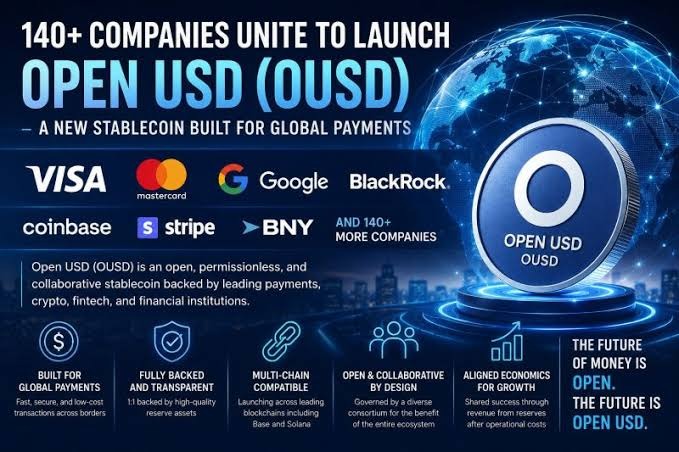
At the heart of this rebellion sits a structural overhaul of how programmable money generates and distributes value. Under the old framework, Circle tightly controls the interest revenue generated by USDC’s USD 74 billion market cap. In contrast, the Open USD stablecoin launch introduces a zero-fee minting and redemption process. It features absolutely no volume caps for enterprise participants.
More importantly, the foundational architecture dictates a programmatic distribution of reserve earnings. Nearly all interest earned on the short-term Treasury reserves backing OUSD will flow back to the commercial partners. These partners are the ones that actually route the transaction volume and hold the balances. By stripping away the issuer-level profit margin and retaining only a minimal baseline management fee, the consortium shifts the competitive landscape. Success no longer depends on owning the largest balance sheet. Instead, it relies on orchestrating the most expansive distribution network.
Capital Markets React to the Open USD Stablecoin Launch
The immediate capital market reaction underscored how deeply this new model threatens established crypto-native giants. Upon the initial Bloomberg disclosure, shares of Circle Internet Group (CRCL) precipitously dropped between 16% and 18% in intraday trading. This sudden equity contraction dragged the stock’s Relative Strength Index into heavily oversold territory.


Wall Street analysts now realize that the high-interest-rate windfalls fueling single-issuer profitability are fragile. To put this into perspective, interest earned on USDC reserves accounted for an astonishing 95% of Circle’s total revenue in the fourth quarter of 2025. It generated USD 733 million in that single quarter alone. The market’s immediate punishment of Circle’s stock proves that investors are actively pricing in the demise of localized yield-hoarding.
Strategic Corporate Chess and Leveraged Renewals
The timing of the Open Standard announcement is highly calculated. It strategically intersects with major corporate renewals to maximize structural leverage. A prime example of this corporate chess game is the looming August 2026 contract renewal between Coinbase and Circle. This landmark three-year revenue-sharing agreement yielded approximately USD 1.4 billion for Coinbase in 2025 alone.
By publicly signing on as a principal launch partner for Open USD, Coinbase effectively handed itself an immense bargaining chip. It did this less than two months before arriving at the negotiating table with Circle. Consequently, Circle is no longer just defending USDC’s day-to-day market share against Tether. It is actively fighting to maintain the leverage required to dictate how yield splits are determined across its entire legacy distribution ecosystem.
Activating Global Economic Plumbing
Beyond immediate corporate positioning, the composition of the Open Standard coalition reads like a cross-section of global finance. This alliance virtually eliminates the distribution bottlenecks that typically stifle new stablecoins. The group brings together global payment networks like Visa, Mastercard, American Express, and Discover alongside asset management behemoths like BlackRock and banking titans like BNY and Standard Chartered.
On the enterprise commerce front, technology giants Google and Shopify have anchored themselves to the standard. Crypto infrastructure is represented by Coinbase, Ripple, and MetaMask. This unprecedented initial alignment of commercial incentives means that OUSD will bypass slow, retail-driven onboarding curves. It plugs directly into pre-existing, multi-trillion-dollar transaction funnels at launch.
Proven Infrastructure Architects at the Helm
To ensure frictionless operational integration, proven architects of modern financial infrastructure are steering commercial execution. Zach Abrams, the co-founder and CEO of the stablecoin enterprise Bridge—which Stripe acquired for USD 1.1 billion—serves as Open Standard’s founding Chief Executive Officer.
Under this leadership, Stripe has already announced that it will make OUSD the default stablecoin across its global merchant payment platform. This allows millions of digital businesses to settle transactions natively on-chain. This structural alignment perfectly realizes a platform economic model. The core payment infrastructure acts as a network growth mechanism rather than a closed-loop profit extraction center.
An Aggressive Multi-Chain Engineering Roadmap
The engineering roadmap highlights an aggressive multi-chain deployment strategy optimized for immediate enterprise and decentralized finance (DeFi) utility. Open Standard has finalized technical protocols to ensure the stablecoin launches with native multi-chain support. It anchors its primary liquidity layer onto high-throughput networks like Solana and the Stellar blockchain, alongside prominent Ethereum Layer-2 scaling solutions such as Base and Polygon.
Furthermore, institutions like Tempo have committed to native issuance from day one. This guarantees that automated market makers, decentralized exchanges, and liquidity pools will have deeply integrated OUSD trading pairs ready to absorb corporate volume the moment the token goes live. This setup ensures that the digital dollar rail matches the speed and transaction throughput required by institutional treasuries.
The Global Push for Consortium-Based Payment Rails
This structural migration toward consortium-based programmable fiat is part of a broader global push to redefine institutional payment rails. Across the Atlantic, European financial institutions have similarly consolidated under the Qivalis initiative. This consortium of 37 major regional banks and payment providers, including ING, UniCredit, and BNP Paribas, is developing a MiCA-compliant Euro stablecoin slated for a 2026 rollout.
The parallel emergence of Qivalis and the Open USD stablecoin launch demonstrates that the global banking establishment is systematically pushing back against single-issuer monopolies. These institutions are explicitly preparing for a macroeconomic shift. Stablecoins are evolving from speculative crypto-native sideshows into the primary plumbing for cross-border B2B commerce.
Ultimately, while the actual OUSD token circulation is slated to go live in late 2026, the structural shockwaves of the Open Standard rebellion have already irrevocably altered the digital asset landscape. The initiative forces the entire fintech sector to comply with a new baseline expectation. Businesses now demand a direct share of the macroeconomic yield their transaction volume generates. As federal oversight crystallizes under the strict banking frameworks established by the U.S. GENIUS Act, the era of the isolated, high-margin crypto issuer is rapidly drawing to a close. The launch of Open Standard will likely be remembered as the exact historical turning point where the financial industry began competing over the open-source operating system of money itself.