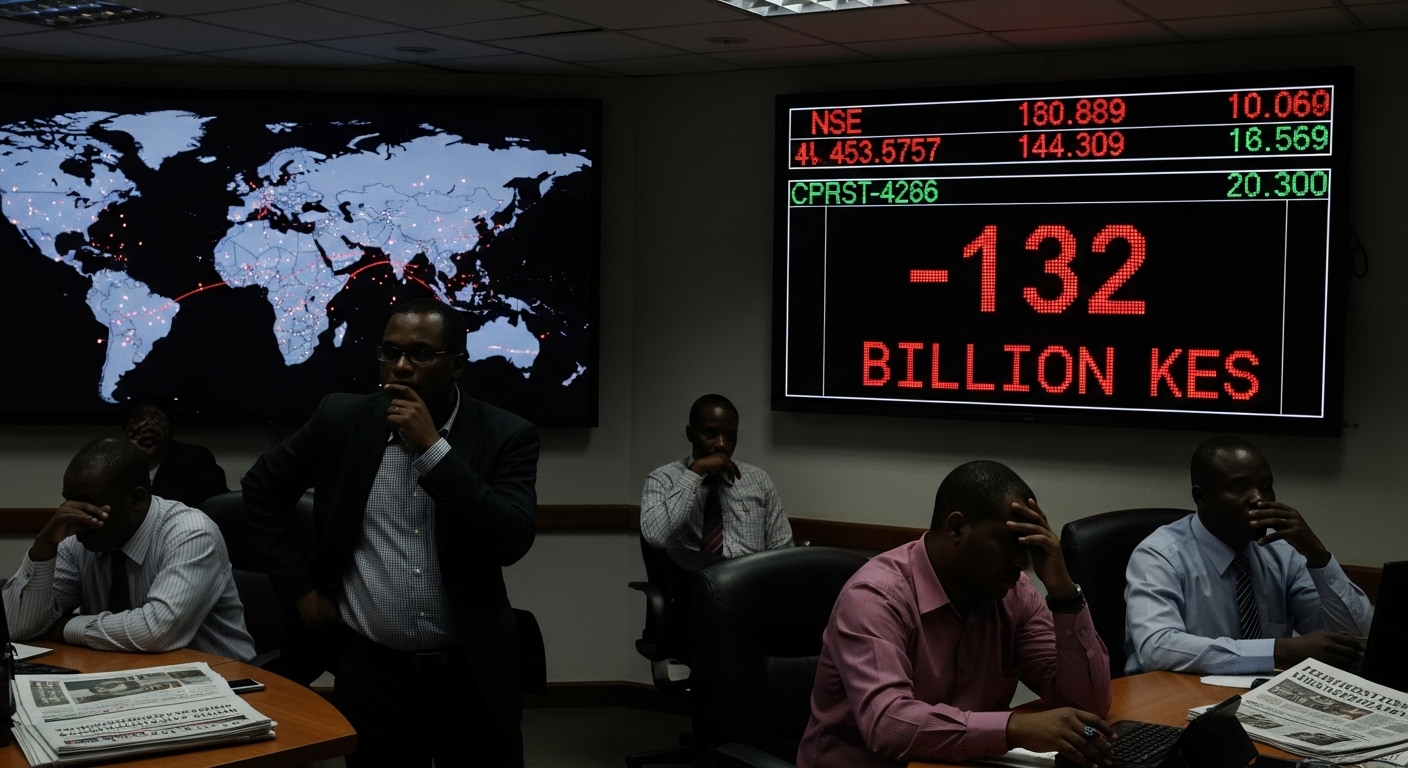
Kenya’s stock market has come under pressure this week after the Nairobi Securities Exchange (NSE) shed approximately Sh132.7 billion in market value over four trading sessions, reflecting investor caution following the escalating conflict involving Israel, Iran and the United States.
The sell-off marks the biggest weekly loss in market capitalisation so far this year, temporarily reversing some of the gains recorded earlier in 2025 when equities rallied strongly on improved economic conditions and lower interest rates.
Institutional Investors Move to Safer Positions
According to Business Daily, Market analysts say the decline has largely been driven by local institutional investors who are trimming their exposure to equities and increasing holdings of cash and cash equivalents.
The move reflects growing caution in global markets as the Middle East conflict raises fears of disruptions to oil supply chains and a potential resurgence in global inflation.


The uncertainty has already pushed investors worldwide toward safer assets, particularly the US dollar, while equities and bonds have experienced selling pressure across major financial markets.
According to global market data cited by Reuters, equity funds recorded outflows of about $9.1 billion in a single day earlier this week, the highest withdrawal in two months.
Heavyweights Lead Market Decline
Several large companies listed on the NSE accounted for the bulk of the market value decline.
Among the biggest contributors were:
-
Safaricom – Sh50.08 billion drop in market value
-
KCB Group – Sh19.3 billion decline
-
Absa Bank Kenya – Sh14.4 billion loss
-
Equity Group Holdings – Sh10.4 billion drop
These firms hold significant weight in the stock market index, meaning movements in their share prices have an outsized effect on the overall market valuation.
The selling pressure has come even as the market had recently experienced a strong rally that boosted investor returns earlier in the year.
Foreign Investors Buck the Trend
While local institutions have been reducing exposure, foreign investors have taken the opposite position.
Between Monday and Wednesday this week, foreign investors recorded net purchases of approximately Sh672 million in Kenyan equities. This contrasts with the previous week when they were net sellers, offloading about Sh910.5 million worth of shares.
Analysts note that for international investors, Kenyan equities represent only a small portion of their global portfolios, allowing them to take advantage of temporary price dips.
Local institutional investors, however, tend to have a larger share of their assets invested in domestic markets, making them more sensitive to shifts in economic risks.
Currency Pressure and Inflation Concerns
The conflict has also begun to affect Kenya’s currency markets.
According to the Central Bank of Kenya, the Kenyan shilling weakened slightly to Sh129.20 against the US dollar after holding steady at around Sh129.02 for nearly three weeks.
The weakening reflects broader global demand for the dollar as investors seek safer assets during periods of geopolitical uncertainty.
A prolonged conflict in the Middle East could also push oil prices higher, a development that would have direct consequences for Kenya, which imports most of its petroleum products from Gulf producers such as Saudi Arabia and the United Arab Emirates.
Higher fuel prices could translate into increased transport costs, rising consumer prices and renewed inflationary pressure.
A Bull Run Now Facing Global Risks
The recent market pullback comes after an extended rally on the NSE that was fuelled by lower interest rates and improving macroeconomic stability.
Over the past 18 months, the Central Bank has been easing monetary policy as inflation remained stable and the shilling relatively steady. Since August 2024, the regulator has cut its benchmark interest rate ten times, bringing it down from 13 percent to 8.75 percent.
Lower returns from fixed-income assets such as Treasury bills and bonds encouraged investors to shift funds into equities, boosting the stock market.
As a result, the NSE added roughly Sh1.34 trillion in market capitalisation since the beginning of 2025, reaching around Sh3.27 trillion before the recent decline.
Global Events Now Driving Local Markets
However, analysts warn that the current geopolitical tensions could disrupt this trend if they persist.
A prolonged rise in global oil prices could reignite inflation and potentially force policymakers to reconsider the current easing cycle. That would increase bond yields and reduce the attractiveness of equities relative to fixed-income investments.
For now, the Central Bank says it will continue monitoring both domestic economic conditions and global developments before making further policy decisions.
The latest developments illustrate how closely Kenya’s financial markets are tied to global events, with geopolitical shocks thousands of kilometres away capable of quickly influencing investor behaviour in Nairobi.