Kenya’s inflation trend has shown signs of moderation after several months of elevated price pressures providing some relief to households, businesses, and investors. While the cost of living remains relatively high, the latest economic indicators suggest that inflation is gradually stabilizing. This shift has important implications for consumer spending, business planning, borrowing costs and investment decisions across the economy.
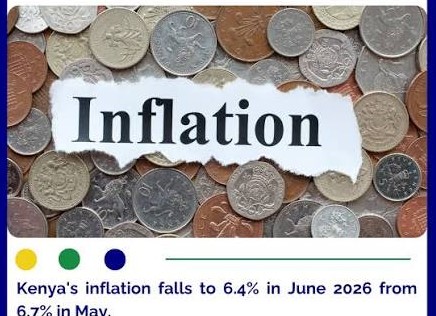
According to the latest data published by the Kenya National Bureau of Statistics (KNBS), Kenya’s annual headline inflation rate declined to 6.4% in June 2026, down from 6.7% in May 2026, representing a 0.3 percentage point decrease. The moderation indicates that the rapid pace of price increases experienced earlier in the year is beginning to ease, although inflation remains above the midpoint of the Central Bank of Kenya’s preferred target range.
The earlier increase in inflation was largely driven by rising transport and energy costs, alongside persistent increases in food prices. Transport costs recorded an annual increase of 16.5%, reflecting higher diesel prices that raised the cost of moving goods and passengers across the country. Food and non-alcoholic beverage prices also remained elevated, rising by 9.4%, continuing to place pressure on household budgets since food accounts for a significant share of consumer expenditure.
The recent decline in inflation suggests that several of these pressures are beginning to soften. Improved domestic food supplies have helped stabilize food prices, while the continued stability of the Kenyan shilling against major international currencies has reduced the cost of imported goods. These developments have contributed to slower overall price growth and improved inflation expectations.


Monetary policy has also remained supportive of price stability. The Central Bank of Kenya maintained its Central Bank Rate (CBR) at 8.75%, signaling confidence that inflationary pressures are gradually coming under control while continuing to support economic activity. Holding the policy rate steady provides businesses and financial institutions with greater certainty when making investment and lending decisions.
Commercial lending conditions have remained relatively stable under the current interest rate environment. Average lending rates are estimated at approximately 14.5%, while savings accounts continue to offer returns of around 6.8%. Although borrowing costs remain relatively high for many households and businesses, stable interest rates reduce uncertainty and support longer-term financial planning.
Higher interest rates have also influenced how financial institutions allocate their funds. Rather than increasing exposure to higher-risk lending, many banks continue to invest a larger share of their liquidity in government securities, which offer predictable returns with minimal credit risk. This trend has strengthened demand for Treasury securities while limiting the expansion of private sector credit.
For households, the economic environment remains mixed. Although inflation is slowing, wage growth has not kept pace with previous increases in the prices of food, transport, and other essential goods. As a result, many families continue to experience pressure on disposable income, leading to more cautious spending patterns and increased emphasis on budgeting and savings.
Corporate performance may also remain uneven as consumer demand adjusts to higher living costs. Businesses operating in sectors heavily dependent on discretionary household spending could experience slower revenue growth, potentially affecting profitability and dividend distributions. Investors may therefore continue to evaluate companies carefully based on their resilience to changing consumer behaviour.
In the current environment, government securities continue to present an attractive option for conservative investors. According to the latest Central Bank of Kenya Treasury bill auction results, the 91-day Treasury bill offers a return of approximately 8.8%. Since this yield exceeds the prevailing inflation rate of 6.4%, investors are able to earn a positive real return while benefiting from the security associated with government-backed investments.
Overall, Kenya’s latest inflation data points to a gradual improvement in macroeconomic stability. Although price levels remain elevated compared to previous years, the slowdown in inflation, stable monetary policy, and attractive government security yields provide encouraging signs for consumers, businesses, and investors. If favorable food supply conditions continue and external economic shocks remain limited, Kenya may experience a more stable inflation environment during the remainder of 2026, supporting sustainable economic growth and improved financial confidence.