


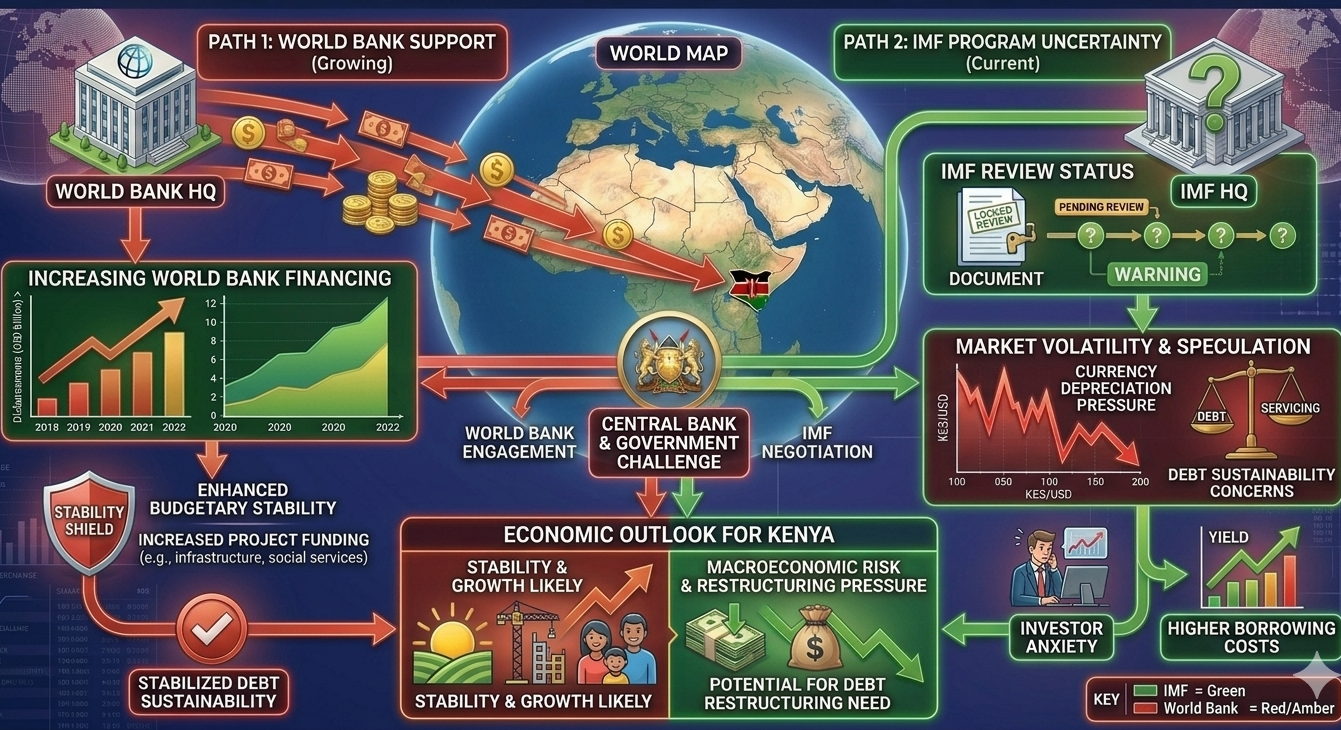
Kenya’s fiscal outlook is increasingly being shaped by uncertainty surrounding negotiations for a successor programme with the International Monetary Fund (IMF), even as the World Bank expands its financial support to the country. The evolving relationship between Kenya and its multilateral lenders highlights the critical role that IMF engagement plays not only in providing external financing but also in reinforcing policy credibility, fiscal discipline, and structural reforms.
The government’s decision to exclude IMF financing from budget projections through 2030 reflects the uncertainty surrounding ongoing negotiations and the stringent policy conditions associated with a new arrangement. This marks a notable shift from previous fiscal planning frameworks, where IMF disbursements formed an important component of external financing assumptions and helped anchor investor confidence in Kenya’s macroeconomic management.
In contrast, the World Bank has continued to strengthen its support for Kenya’s financing requirements. The institution recently approved a loan amounting to KSh 97.0 bn while reaffirming ongoing collaboration with the IMF to facilitate discussions towards a new programme. In addition, the IMF has completed a draft Governance Diagnostic Assessment aimed at identifying governance gaps and corruption vulnerabilities that may require policy interventions before a new agreement can be finalized.
Kenya has operated without active IMF financial support since March 2025 following the expiry of the previous programme after several conditions remained unmet. The lapse resulted in approximately KSh 110.0 bn in undisbursed financing that had been expected under the arrangement. The earlier programme consisted of a KSh 310.8 bn Extended Credit Facility and Extended Fund Facility package alongside a KSh 71.4 bn Resilience and Sustainability Facility, both structured over a 48-month period beginning in February 2021.


During implementation, the programme completed eight successful reviews and generated cumulative disbursements of KSh 404.0 bn under the Extended Credit Facility and Extended Fund Facility components, in addition to KSh 23.3 bn provided through the Resilience and Sustainability Facility. These resources played an important role in supporting budget financing, strengthening foreign exchange reserves, and cushioning the economy against external shocks during a period characterized by elevated debt servicing obligations and global economic volatility.
The World Bank has nevertheless cautioned that delays in securing a successor IMF arrangement could weaken confidence in Kenya’s fiscal framework and slow progress towards fiscal consolidation. Several external risks continue to cloud the outlook, including prolonged geopolitical tensions in the Middle East that could sustain higher fuel and fertilizer prices, weaker growth in diaspora remittances, and heightened political uncertainty ahead of the August 2027 General Election.
The institution further identifies tighter global financial conditions and rising refinancing costs as potential constraints on economic activity. Higher borrowing costs could increase debt servicing pressures while simultaneously crowding out private sector credit, limiting investment and slowing economic expansion.
Despite these concerns, continued World Bank financing provides an important short-term buffer for Kenya’s funding needs. Government projections indicate that annual borrowing from the World Bank is expected to increase to KSh 170.5 bn from KSh 129.8 bn in the current fiscal year and remain elevated over the next four budget cycles. This financing offers relatively longer maturities and less restrictive conditions compared to commercial borrowing options.
However, World Bank funding alone may not fully substitute the policy credibility associated with an IMF-supported programme. IMF engagement has historically served as an important signal to international investors regarding commitment to fiscal reforms, debt sustainability, and macroeconomic stability. Consequently, uncertainty surrounding a successor programme is likely to remain a key consideration for investors assessing Kenya’s risk profile.
Going forward, progress in fiscal reforms, public debt management, and IMF negotiations will remain central determinants of Kenya’s investment outlook. While the World Bank’s continued support strengthens short-term financing resilience, securing a new IMF arrangement is likely to play a critical role in sustaining investor confidence and reinforcing long-term macroeconomic stability.


