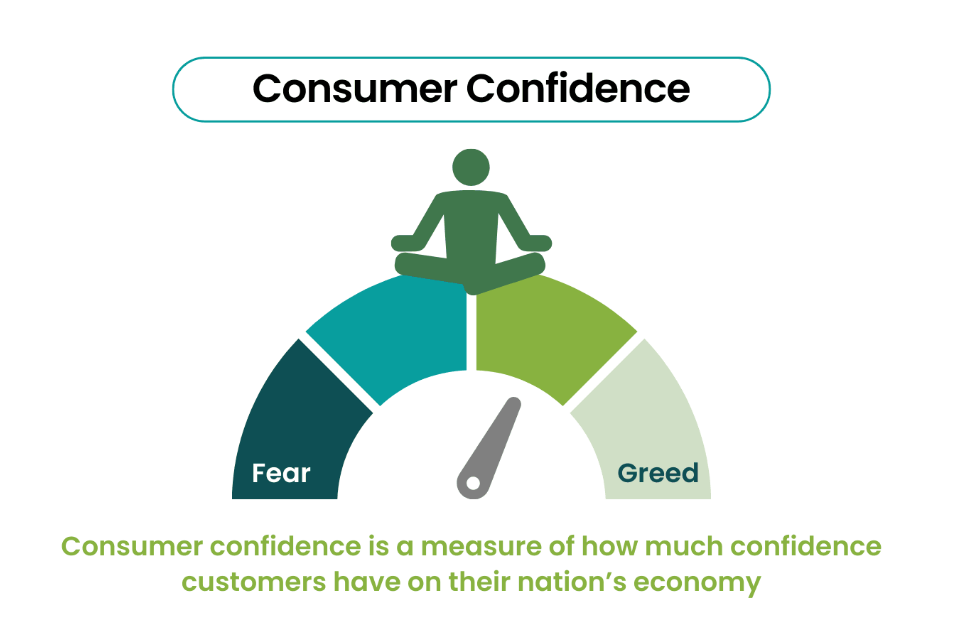
Consumer confidence is an important economic indicator that reflects how optimistic or pessimistic households are about current and future economic conditions. It influences spending behavior, savings patterns, and investment activity, making it a significant factor in financial market performance. Since consumer spending forms a large portion of economic activity in many economies, shifts in confidence levels can have broad implications for businesses, investors, and policymakers.
When consumer confidence is high, households are generally more willing to spend on goods and services, take on credit, and make long-term financial commitments such as purchasing homes or vehicles. Increased spending supports business revenues and profitability, which can positively affect equity markets. Companies in sectors such as retail, banking, manufacturing, and consumer services often benefit from stronger consumer demand during periods of elevated confidence.
In contrast, declining consumer confidence may lead households to reduce discretionary spending and increase precautionary savings. This behavior can slow economic activity, reduce corporate earnings, and weaken investor sentiment. Financial markets may respond negatively if reduced consumer spending is expected to affect economic growth and business performance over the medium term.
Consumer confidence also influences labor market dynamics. Optimistic consumers are more likely to feel secure in their employment prospects and future income levels, which encourages spending and investment. Strong labor market conditions can reinforce confidence, creating a cycle that supports economic expansion. On the other hand, rising unemployment or uncertainty about income can weaken sentiment and contribute to slower economic growth.
RELATEDPOSTS


Interest rates and inflation are closely linked to consumer confidence as well. Stable inflation and manageable borrowing costs generally support household purchasing power and financial stability. However, high inflation can erode real incomes, reducing consumers’ ability to spend. Similarly, rising interest rates may increase the cost of borrowing, affecting consumption and investment decisions. These factors often influence how consumers perceive the broader economic environment.
Financial markets frequently monitor consumer confidence indicators because they provide insight into future economic trends. Equity investors, in particular, may use confidence data to assess potential changes in consumer demand and corporate earnings. Bond markets can also be affected, as shifts in confidence may influence expectations regarding economic growth and monetary policy.
Consumer confidence is also important for investment-related industries such as real estate and financial services. Higher confidence can encourage participation in housing markets and increase demand for financial products, including loans and investment instruments. Conversely, uncertainty may lead consumers to delay major financial decisions, affecting market activity in these sectors.
External events and global economic conditions can influence consumer sentiment as well. Factors such as geopolitical developments, commodity price changes, and global financial volatility may affect perceptions about economic stability and future prospects. In increasingly interconnected economies, consumer confidence can therefore be influenced by both domestic and international developments.
Despite its importance, consumer confidence is not always perfectly aligned with actual economic performance. Sentiment can sometimes be driven by short-term events or emotional reactions that may not fully reflect underlying economic fundamentals. For this reason, investors often analyze confidence indicators alongside broader macroeconomic data.
In conclusion, consumer confidence plays a significant role in shaping financial market performance and economic activity. By influencing spending, investment behavior, and business expectations, confidence levels contribute to the overall direction of markets and economic growth. Understanding these dynamics helps investors and policymakers assess economic conditions and anticipate potential market trends.