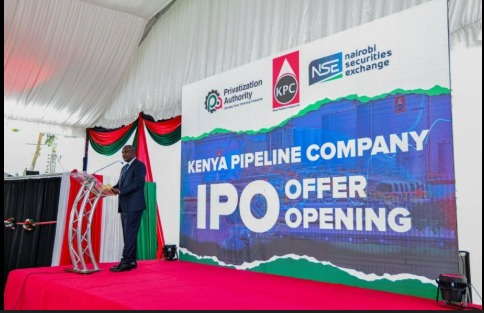
The IPO of Kenya Pipeline Company drew strong demand but revealed weak participation from retail investors, foreign buyers, and oil marketing firms, with Uganda and local institutional investors driving the sale. The offer raised Sh112 billion, exceeding the government’s target of Sh106 billion, achieving a 105.7 percent subscription rate, according to Treasury Cabinet Secretary John Mbadi. Most demand came from institutional investors and Uganda’s state-owned oil company, leaving other key investors far below their allocations.
Local retail investors bought shares worth Sh4.1 billion, far below their Sh21.2 billion allocation. Foreign investors committed only Sh34.8 million against a Sh21.2 billion target. Oil marketing companies, which rely heavily on the pipeline, purchased just Sh23.1 million, or 0.14 percent of their Sh15.9 billion allocation. This was below expectations, as both retail investors and oil marketers were expected to see the pipeline as a strategic long-term investment.
Strong local institutional demand filled the gap. 465 investors, including the National Social Security Fund and Public Service Superannuation Fund, invested Sh67 billion, exceeding their allocation of Sh21.1 billion by 216 percent. East African investors, dominated by Uganda National Oil Company, oversubscribed their Sh21.2 billion allocation, buying Sh34.7 billion worth of shares. Without this, the IPO could have failed to meet the minimum threshold of Sh53.1 billion from over 250 investors.
The IPO opened on January 19 at Sh9 per share, Kenya’s largest public share sale since the Safaricom IPO in 2008. Analysts and investors raised concerns about valuation and the company’s financial strategy. Kenya Pipeline plans to cut its dividend payout ratio from 94.5 percent of profits to 50 percent while committing to major capital expenditure, including a new Mombasa–Nairobi pipeline. This made the stock less attractive to short-term dividend-focused investors. Standard Investment Bank recommended it for long-term investors, noting the company’s fundamentals favour patient capital.
Faida Investment Bank, the lead adviser, noted the strategic nature of the IPO, reflected in institutional and Uganda participation. Institutional investors typically take a long-term view, while oil marketers like Vivo Energy largely stayed on the sidelines, citing valuation concerns, delayed board approvals, and uncertainty over joint or individual participation. They may still increase ownership once secondary market trading begins.
Retail participation remained modest, with only 73,000 investors applying, compared to over 800,000 for the Safaricom IPO. Employees bought Sh99.1 million worth of shares against a Sh5.3 billion allocation, exceeding uptake by foreign investors and oil marketers.
Uganda secured a 20 percent stake with governance concessions, including two board seats and veto rights over key decisions such as CEO appointments. Kampala’s initial threat to withdraw could have removed nearly Sh30 billion from the IPO, jeopardizing the transaction. Uganda’s investment strengthens regional energy cooperation and access to fuel infrastructure. Over half of petroleum products transported via Kenya Pipeline are exported: Uganda accounts for roughly two-thirds, Eastern DRC 19 percent, South Sudan 15 percent, and Rwanda 15 percent. Service fees in the year to June saw Uganda National Oil Company pay Sh1.2 billion, making it the sixth-largest customer, while Vivo Energy paid Sh4.94 billion.
Following the sale, the government retains a 35 percent stake. Of the offered shares, 15 percent were for oil marketing companies, five percent for employees, and the remainder divided equally among local retail, local institutional, East African, and foreign investors at 20 percent each. Proceeds will fund the national infrastructure fund, supporting highways, railways, ports, and energy projects. With public debt high and loan repayments consuming 40 percent of government revenue, the Treasury increasingly relies on asset sales. Kenya Pipeline shares are set to begin trading on the Nairobi Securities Exchange on March 9, marking a major milestone in the government’s privatization agenda.