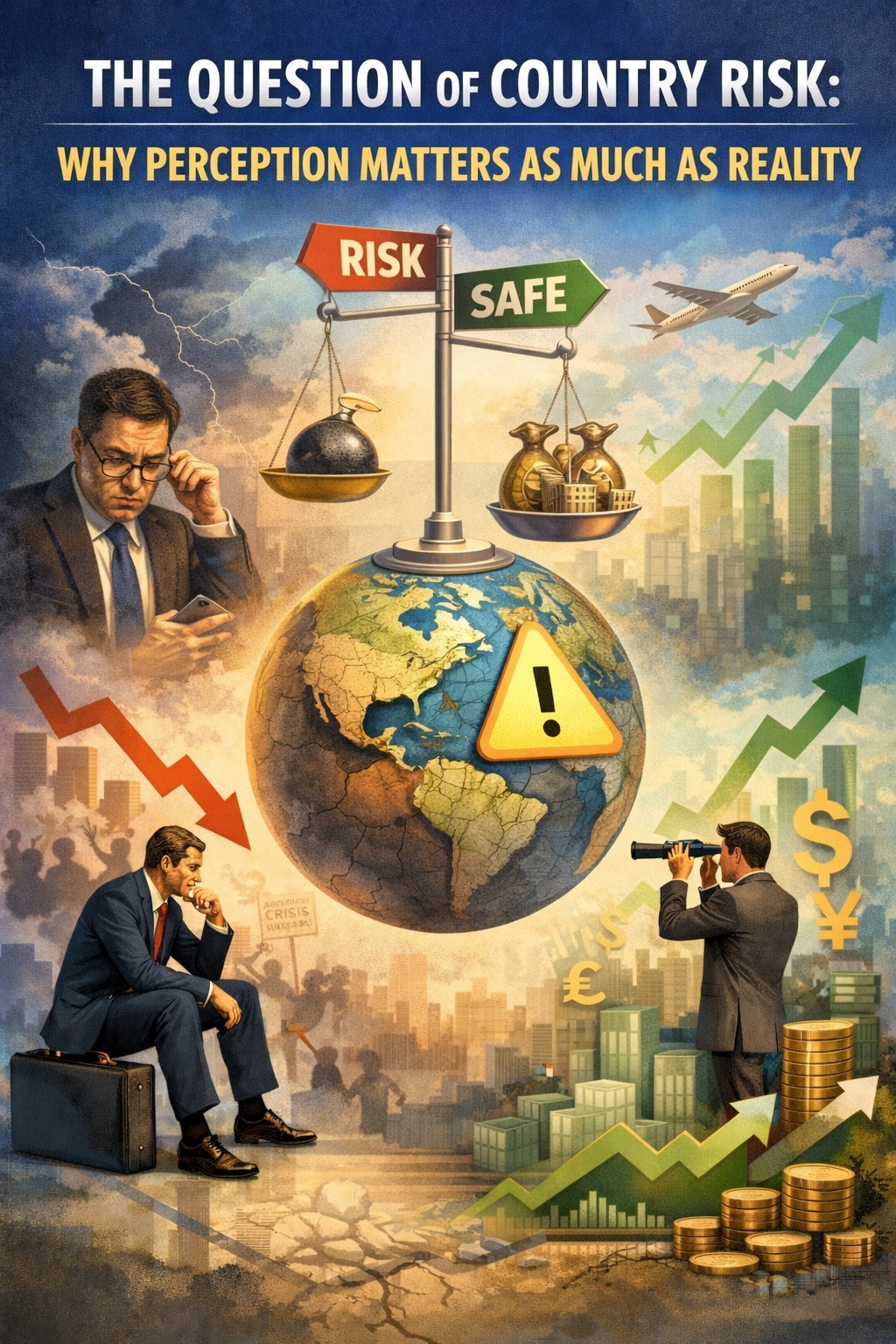
Country risk is often discussed in technical terms; debt ratios, fiscal balances, exchange rate stability, and institutional strength. Yet in practice, it is as much about perception as it is about data. Across Kenya and many African economies, how investors, lenders, and businesses interpret the outlook can influence economic outcomes just as strongly as underlying fundamentals.
At its core, country risk reflects the possibility that economic or policy conditions may change in ways that affect returns. In Kenya, this risk is priced into government borrowing costs, corporate bond yields, and even mortgage rates. When perceived risk rises, the cost of capital increases, not only for the government, but for private businesses that borrow in the same market.

Perception matters because markets move faster than policy. In recent years, shifts in global risk appetite have led investors to reassess exposure to frontier and emerging markets, including Africa. Even when domestic indicators such as consumer demand or private sector activity remain resilient, changes in sentiment can trigger currency pressure, tighter liquidity, and higher required returns. These reactions are often driven by expectations rather than immediate deterioration.
The impact is visible at the business level. Kenyan firms operating in capital-intensive sectors such as construction, manufacturing, and real estate tend to become more cautious when country risk perceptions rise. Expansion plans are delayed, projects are phased more slowly, and balance sheets are managed conservatively. This behavior mirrors patterns seen across Africa, where businesses often prioritize cash preservation during periods of heightened uncertainty.
Country risk also influences credit markets. Banks and lenders respond by shortening loan tenors, tightening underwriting standards, or favoring sectors perceived as defensive. Small and medium-sized enterprises, already sensitive to financing conditions, feel these effects most acutely. The result is slower credit growth, even when underlying economic activity has not fundamentally weakened.
Importantly, perception does not always align perfectly with reality. Several African economies have demonstrated strong private sector resilience, diversified revenue sources, and improving institutional frameworks, yet continue to face elevated risk premiums. This disconnect highlights that managing country risk is not only about improving economic fundamentals, but also about credibility, consistency, and clear policy signaling.
For policymakers, predictability is critical. Stable monetary frameworks, transparent fiscal management, and coherent long-term strategies help anchor expectations. Over time, this reduces uncertainty premiums and allows markets to distinguish between temporary shocks and structural weakness.
Ultimately, the question of country risk is not whether it exists, every economy carries it, but how it is understood and priced. In Kenya and across Africa, narrowing the gap between perception and reality remains central to attracting sustainable investment and supporting long-term growth.
Start your investment journey today with the Cytonn Money Market Fund. Call + 254 (0)709101200 or email sales@cytonn.com