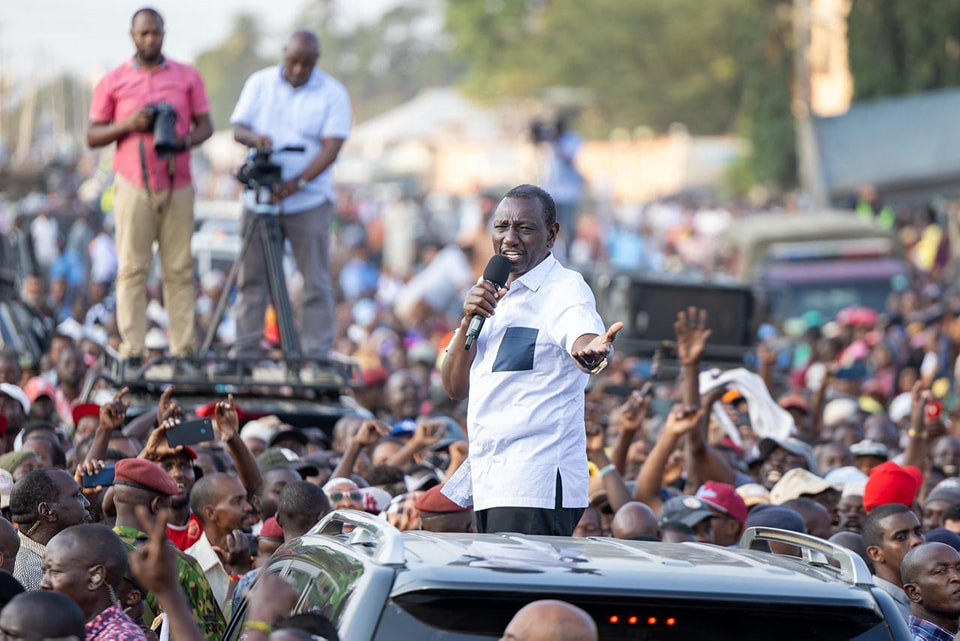
President William Ruto of Kenya staunchly defended his frequent international travels during a townhall meeting at the Kenya School of Government in Mombasa, framing them as crucial economic diplomacy efforts to secure opportunities for the nation and its citizens.
“I have been travelling to make sure that I connect Kenyans to jobs both in country and outside country,” Ruto told the audience, addressing criticism of his numerous foreign trips since taking office. The President emphasized that these journeys were not mere diplomatic formalities but strategic moves to boost Kenya’s economy and create employment opportunities.
Ruto outlined several key initiatives and policies aimed at stimulating economic growth and job creation. He highlighted the government’s housing program as a significant source of employment, stating, “Our housing program is creating jobs.” The President also detailed efforts to harness the digital economy, revealing plans to establish ICT hubs in every ward to connect “millions of young people to jobs on the digital space.”
In a bid to address youth unemployment, Ruto announced the signing of 19 bilateral labour agreements with various countries. “We are signing 19 bilateral labour agreements with different countries. In fact, we just concluded one with Germany,” he said.


The President also emphasized his focus on boosting local manufacturing to create jobs and reduce imports. “We must begin to manufacture things, products that can be manufactured in Kenya, instead of importing everything from everywhere,” Ruto asserted. He cited examples of how imposing duties on certain imports had revitalized local industries, claiming that 11 steel companies that had previously closed down were now operational, employing 16,000 Kenyans.
On education, Ruto explained the rationale behind the new university funding model, which aims to provide more support to students from less privileged backgrounds. “We change the model so that children from vulnerable families, children from parents who are less endowed, we move them from getting 80 percent to getting 90, 95%,” he said. The President also announced plans to construct more student hostels to improve accommodation for university students.
Turning to tourism, a crucial sector for Kenya’s economy, Ruto set an ambitious target of increasing annual tourist arrivals to 5 million by 2027-2028. He discussed plans to ease visa requirements and improve airport infrastructure through public-private partnerships to achieve this goal.
The blue economy featured prominently in Ruto’s address, with the President detailing investments in deep-sea fishing boats and the licensing of industrial fishing vessels. “We are now going to buy another 25 fishing, deep-sea fishing boats, that can take a day or two, into the deep sea, to be able to get us the fish that we want for our country,” he stated.
Addressing concerns about governance and transparency, Ruto promised to protect constitutional rights and individual freedoms. “There will be no disappearance of Kenyans. I gave that undertaking. There will be no Kenyans in Riva Yala,” he assured the audience, referencing past human rights concerns.