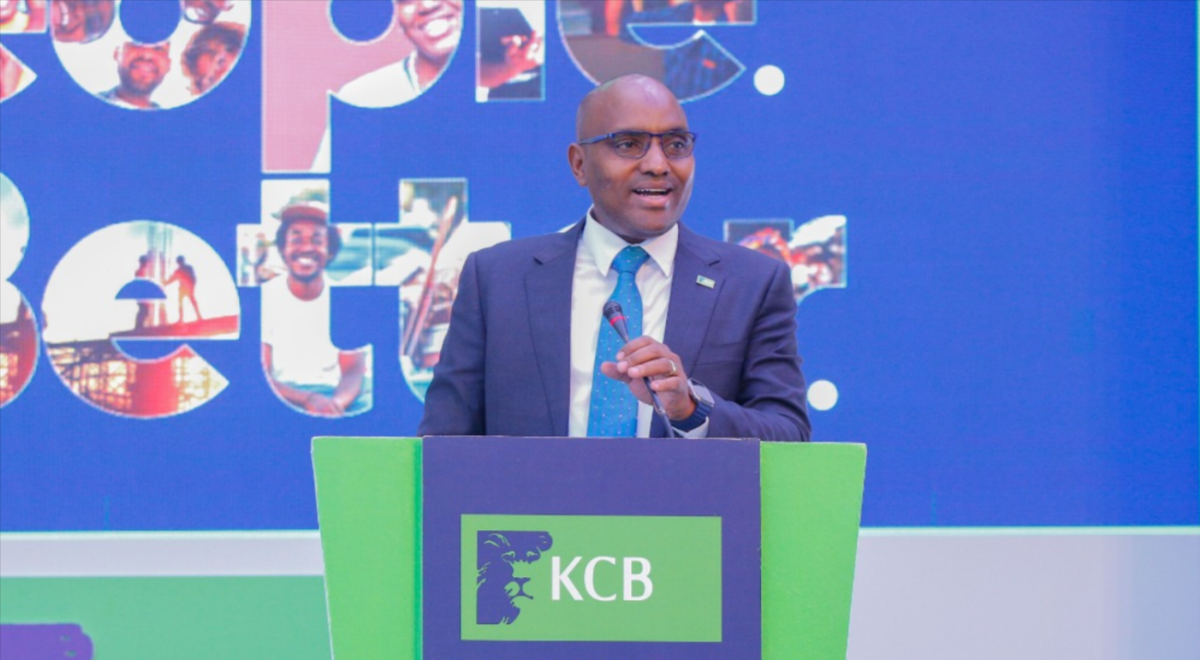
KCB Group’s Q1’2024 results released on Wednesday reveal a substantial increase in net profits, nearly doubling to KES 16.5 billion from KES 9.8 billion in the same period in 2022, marking a 69.0% growth.
Group Managing Director and CEO Paul Russo highlighted the performance as historic, attributing it to revenue growth across the bank’s network, pushing the balance sheet to KES 2 trillion from KES 1.6 trillion the previous year. Total revenues surged by 31.6% to Kes 48.5 billion, driven by both funded and non-funded lines.
Non-funded income, comprising 36% of total revenues, benefited from increased transaction volumes due to customer confidence and the adoption of digital banking and alternative channels.
Despite a challenging operating environment in the region, Russo noted a strong revenue performance bolstered by prudent credit, liquidity, cost, and risk management. Consumer deposits grew by 25.4% to KES 1.5 trillion, mainly from the Kenyan market, reflecting clients’ confidence in the brand.

Russo also emphasized the bank’s deliberate investments in digital and payments capabilities, as well as regional expansion, which continued to yield impressive results. The bank focused on operational efficiency through automation of key processes, expansion of self-service channels, and streamlined loan application processes, enhancing customer satisfaction and reducing friction.
The lender reported significant improvements in key financial metrics for the first quarter. Net loans increased by 9.5% to KES 1.0 trillion, driven by additional lending to support business activities. The group’s diversification strategy paid off, with businesses outside KCB Bank Kenya contributing 17.9% of pre-tax profits and 13.1% of total assets.
Operational efficiency improved, with the cost-to-income ratio dropping to 43.3% from 51.2%, attributed to strong income growth and strict cost management. However, total costs rose by 11.3% to KES 21 billion, mainly due to inflationary pressures affecting East Africa and globally.
Loan impairments increased by 53.4% due to downgraded facilities, resulting in a gross non-performing loan (NPL) book of KES 205.3 billion and an NPL ratio of 17.9%. This increase was due to downgrades in Kenya and the impact of foreign currency translations. The group is prioritizing efforts to improve asset quality through various measures aimed at reducing NPL ratios in the short and long term.
Shareholders’ funds grew by 11% to KES 238.6 billion, up from KES 214.8 billion the previous year, indicating an attractive entry point for new shareholders and growth opportunities for existing ones. The lender remains optimistic about business prospects for the remainder of the year.
KCB Group Chairman Joseph Kinyua stated that the bank has made substantial progress in sustaining superior shareholder value through strong financial performance and a future-proof business strategy. The bank’s capital profile remained robust, with a core capital to risk-weighted assets ratio of 15.7% and a total capital to risk-weighted assets ratio of 17.8%, both exceeding regulatory minimums. All banking subsidiaries complied with local regulatory capital requirements, except for NBK.