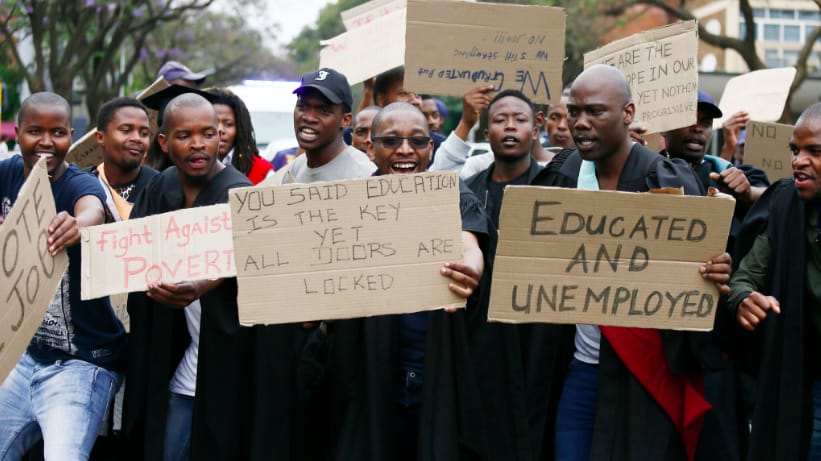
In Kenya, the chasm between economic aspiration and economic reality is most starkly visible in the struggle for dignified work. Joblessness is not merely a statistic; it is a pervasive national challenge that fuels social anxiety, and undermines the very demographic dividend, a large, youthful population, that should be the country’s greatest asset. Despite sustained GDP growth of 4.9% in 2025, this expansion has failed to generate sufficient formal employment which accounts 16.4% of the total share if employment translating to 3.4 mn people, leaving millions of young graduates, skilled workers, and urban migrants in a state of precarious underemployment or outright joblessness. The unemployment rate in 2024 was increased by 0.2% points to 5.4% in 2024 from 5.6% in 2023, which is attributed to the expansion of the construction sector. World bank projects the industry to increase the Country’s GDP growth by 0.4% points to 4.9% in 2025 from the previous projection of 4.5% of the same year.
The dimensions of the crisis are profound. Official figures often mask the true scale, as they typically count only those actively seeking work, overlooking the vast “underemployed” in the informal sector which makes up 83.6% translates to 17.4 mn people. Each year, universities and technical colleges release hundreds of thousands of new graduates into an economy that creates only a fraction of that number in formal, salaried positions. The result is a growing cohort of educated yet frustrated youth, a phenomenon that transforms a potential engine for growth into a source of social and political pressure. The employment rate as declined by 3.2% points to 4.5% in 2025 from 7.7% in 2024.
The roots of this job deficit are multifaceted. A significant disconnect exists between the skills taught in educational institutions and the practical competencies demanded by the modern labor market, particularly in sectors like technology, advanced manufacturing, and specialized services. At the same time, the primary engine of job creation, the private sector, faces its own constraints. High costs of doing business, including expensive credit, unreliable infrastructure, and regulatory bureaucracy, discourage investment and expansion. The manufacturing sector has remained the main employment industry with 347,294. Consequently, the informal sector, or “jua kali,” acts as the default employer for over 83.6% of the workforce, but these are typically survivalist ventures characterized by low productivity, no social security, and extreme vulnerability to economic shocks.
The social and economic consequences of widespread joblessness are severe. It perpetuates cycles of poverty, limits upward mobility, and exacerbates inequality. Idleness among the youth can lead to increased crime, substance abuse, and social unrest, eroding the fabric of communities. On a macroeconomic level, high unemployment represents a catastrophic waste of human capital, constraining domestic consumption, reducing the tax base, and ultimately hampering sustainable economic development.


Addressing this crisis requires a fundamental shift in strategy, moving beyond piecemeal initiatives to a comprehensive national job’s pact. First, education reform must prioritize STEM (Science, Technology, Engineering, and Mathematics), digital literacy, and vocational training aligned with industry needs through stronger public-private partnerships. Second, the government must enact bold reforms to improve the business environment, making it easier and cheaper for small and medium-sized enterprises (SMEs), the true jobs engine, to start, formalize, and grow. This includes access to affordable credit, reliable power, and streamlined licensing. Third, targeted support for high-potential labor-intensive sectors like agro-processing, renewable energy, construction, and the digital economy is essential.
Ultimately, solving Kenya’s joblessness crisis is the defining challenge of this generation. It demands more than economic growth; it requires inclusive, job-intensive growth. It calls for policymakers, educators, and the private sector to align around the singular goal of creating meaningful work for the millions of young Kenyans whose energy and talent, if harnessed, could propel the nation to unprecedented heights. For individuals navigating this tough landscape, building financial literacy and exploring entrepreneurship or personal investment becomes a critical parallel strategy for resilience.Start building your financial security today. Begin your investment journey with the Cytonn Money Market Fund. Call +254 (0)709 101 200 or email sales@cytonn.com.